Korean Dish Names: Hangul, Meanings & Cooking Suffixes
In many Korean dish names, the final word, such as 찌개 (jjigae), 탕 (tang) or 볶음 (bokkeum), tells you the cooking method. Dish names are often built as "main ingredient + cooking method", so if you read the beginning and the end of the Hangul separately, you can work out what kind of dish it is even when the menu has no photos.
🍲 Final words in Korean dish names and their cooking methods
Korean dish names end in a word that indicates a soup, stir-fry, grilled dish and so on. The final word tells you the dish's form (soup, rice dish or noodles), and the first word tells you the main ingredient.
| Final word (Hangul) | Romanization | Meaning |
|---|---|---|
| 찌개 | jjigae | Hearty stew packed with ingredients |
| 탕 / 국 | tang / guk | Soup |
| 볶음 | bokkeum | Stir-fry |
| 구이 | gui | Grilled dish |
| 전 | jeon | Dish coated in flour or egg and pan-fried |
| 무침 | muchim | Seasoned, dressed dish |
| 밥 | bap | Rice |
| 면 | myeon | Noodles |
If you want soup, look for dishes ending in 찌개, 탕 or 국. For a rice dish, look for 밥, and for noodles, look for 면.
🍚 13 popular Korean dishes: Hangul, romanization and meaning
The following 13 dishes are examples where splitting the name into its parts reveals the meaning directly.
| Hangul | Romanization | Meaning (word breakdown) |
|---|---|---|
| 비빔밥 | bibimbap | 비빔 (mixing) + 밥 (rice) = mixed rice |
| 김밥 | gimbap | 김 (seaweed) + 밥 (rice) = seaweed rice roll |
| 김치찌개 | kimchi jjigae | 김치 (kimchi) + 찌개 (stew) = kimchi stew |
| 된장찌개 | doenjang jjigae | 된장 (soybean paste) + 찌개 (stew) = soybean paste stew |
| 순두부찌개 | sundubu jjigae | 순두부 (soft tofu) + 찌개 (stew) |
| 삼계탕 | samgyetang | 삼 (ginseng) + 계 (chicken) + 탕 (soup) |
| 설렁탕 | seolleongtang | A white soup made by simmering beef bones and other ingredients |
| 불고기 | bulgogi | 불 (fire) + 고기 (meat) = marinated grilled meat |
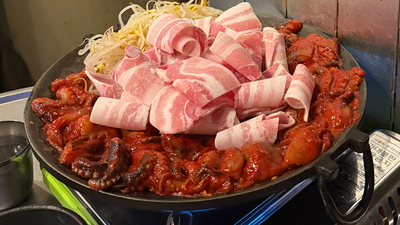
| 삼겹살 | samgyeopsal | 삼 (three) + 겹 (layer) + 살 (meat) = pork belly |
| 제육볶음 | jeyuk bokkeum | 제육 (pork) + 볶음 (stir-fry) |
| 떡볶이 | tteokbokki | 떡 (rice cake) + 볶이 (stir-fry) = stir-fried, simmered rice cakes |
| 냉면 | naengmyeon | 냉 (cold) + 면 (noodles) = cold noodles |
| 잡채 | japchae | Stir-fried glass noodles with vegetables and other ingredients |
The romanizations are only a rough guide. In Korean pronunciation, the first sound of 비빔밥 is closer to a "p" than a "b".
🗣️ Phrases for ordering Korean food
At Korean restaurants, you can order by adding "주세요 (juseyo)", meaning "please", after the dish name.
- Check the final word of the dish name on the menu (찌개, 탕, 밥, etc.) to decide what type of dish you want.
- Use the first word (김치, 된장, 삼계, etc.) to choose the ingredient.
- Say "dish name + 주세요" (for example, 비빔밥 주세요 = bibimbap juseyo).
- If you're not confident about pronunciation, point to the dish name on the menu and say "이거 주세요 (igeo juseyo)", meaning "this one, please".
To order two servings, add "2인분 (i-inbun)" after the dish name, as in "김치찌개 2인분 주세요".
Summary
- Many Korean dish names let you identify the cooking method from the final word, such as 찌개, 탕, 볶음 or 구이.
- For the 13 dishes including 비빔밥, 삼겹살 and 냉면, splitting the name into its parts reveals the "ingredient + cooking method" meaning.
- You can order by saying "dish name + 주세요 (juseyo)", and if you can't read the name, you can point to the menu and say "이거 주세요".
- If you want soup, look for dishes on the menu ending in 찌개, 탕 or 국.
💬 Frequently asked questions
What's the difference between jjigae and tang?
찌개 (jjigae) means a hearty stew packed with ingredients, while 탕 (tang) means soup. Both are soup dishes, and what goes into them varies by ingredient and restaurant. On a menu, you can tell them apart by the final word.
Is it pronounced "bibimbap" or "pibimbap"?
Both refer to the same dish. It's written 비빔밥 in Hangul, and in Korean pronunciation the first sound is closer to a "p", though it's also often spelled "bibimbap". To order, say "비빔밥 주세요".
How much do Korean dishes cost, and how big are the portions?
Prices and portion sizes vary by restaurant, so this article doesn't cover them. Please check each restaurant's menu or official website for the latest information.
Can I order without being able to read Hangul?
Yes. You can point to the dish name on the menu and say "이거 주세요 (igeo juseyo)", meaning "this one, please". When ordering for several people, add the number of servings, such as "2인분 (i-inbun)".
Related Columns