K-Drama Terms of Endearment Between Lovers | Complete Guide to the Meanings and Uses of Jagiya and Oppa


That sweet term of endearment you often hear in Korean dramas.
In fact, it is filled with affection for the other person and the special bond they share💕

Special terms of endearment used by couples in Korean dramas✨
When watching Korean dramas, have you ever wondered about the words lovers whisper to each other in sweet voices…?💕
In Korea, lovers actually do not often call each other by name. Instead, they frequently use special terms of endearment to express the distance between them and the depth of their love.
This time, we will clearly explain the terms of endearment commonly heard between lovers in Korean dramas and what they mean.
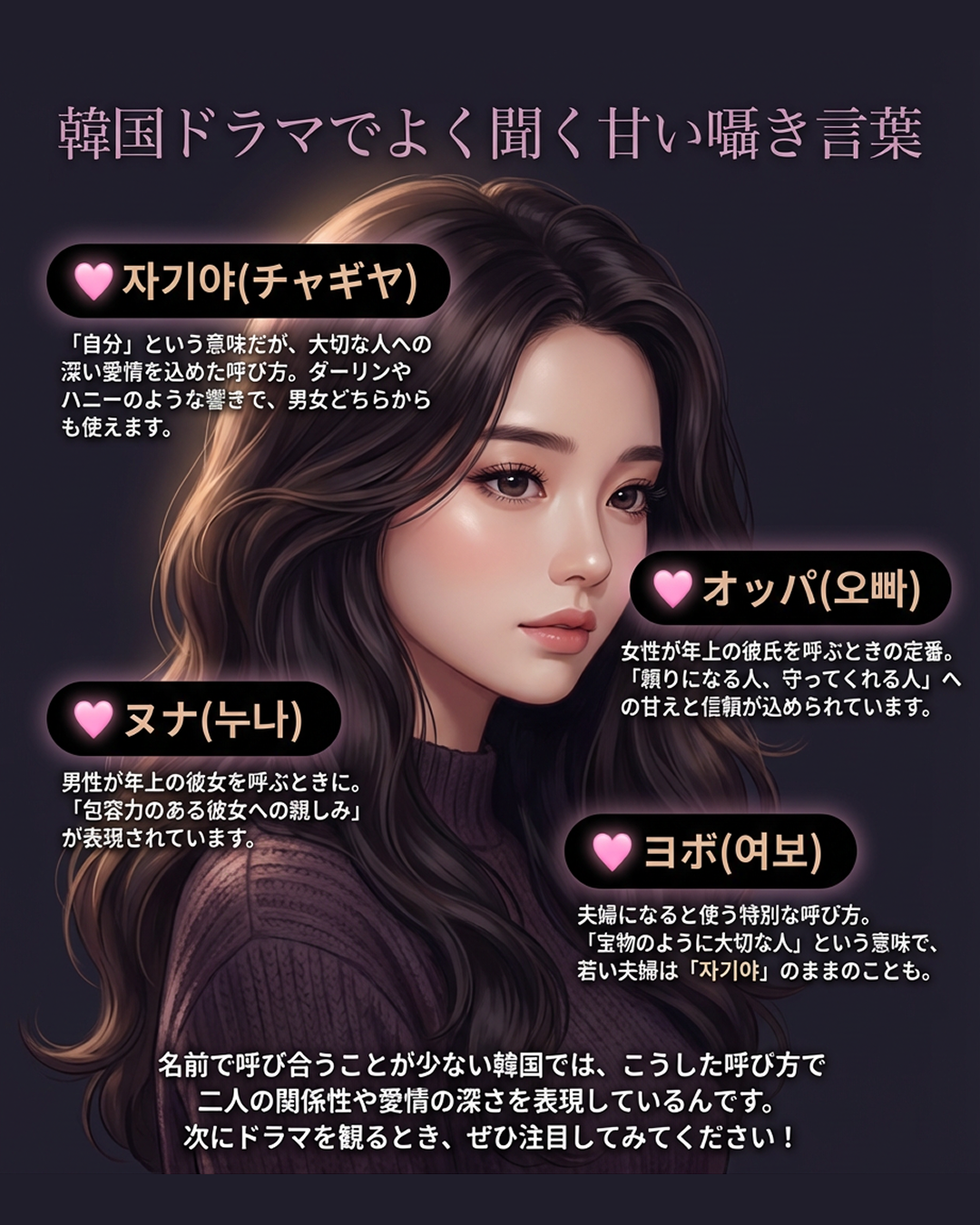
💕자기야(チャギヤ)|The Most Common Term of Endearment Between Lovers
This is the most commonly heard term of endearment between couples.
It literally means “oneself” (= yourself),
but it is used to express deep affection for someone who is “as precious as a part of oneself.”
It has a nuance similar to “darling” or “honey,” and can be used by both men and women.
In Korean dramas, scenes where couples call each other “jagiya~” are a classic staple 💖
💕누나(ヌナ)|A Term of Endearment Used by Men for an Older Girlfriend
This is used by men when calling an older girlfriend.
It means “older sister” and conveys affection and trust toward an older woman, as well as a desire to be pampered.
In Korean dramas, we often see scenes where a younger male character calls an older woman “nuna~,” don’t we?
As “older woman × younger man” couples have become more common recently, this is a term you’re likely to hear more often!
💕여보(ヨボ)|A Classic Term of Address Between Married Couples
This is a classic term of address commonly used by married couples.
Although it is a little difficult to translate literally, it has a nuance similar to “you” or “hey” in Japanese and conveys a sense of closeness.
While many young couples continue to use “자기야(チャギヤ),” couples tend to use “여보(ヨボ)” more as their married life grows longer.
Even in Korean dramas, scenes where married couples routinely call each other “yeobo~” convey a warm family atmosphere, don’t they?
Learning about Korea’s unique “forms of address culture” makes dramas even more enjoyable!
Learning about Korea’s unique “forms of address culture” makes Korean dramas even more enjoyable.
In Korea, where people do not often call each other by their names, these forms of address are frequently used to express the distance between two people and the depth of their affection.
The next time you watch a drama, be sure to pay attention✨
By noticing in what situations forms of address such as “jagiya” and “oppa” are used, you can enjoy Korean dramas on an even deeper level.
So that you can feel closer to Korea and enjoy it with peace of mind.
Yeppuriko has brought you reliable information about Korea.
Bringing you closer to Korea, where trends and exciting discoveries come together—at “Yeppuriko.”
Related Columns
- 4 medications for fever at midnight available at Korean convenience stores
- 6 Negative Expressions in Korean|Real Emotional Phrases Learned from Dramas
- How to Choose a K-Drama So You’ll Never Again Wonder, “What Should I Watch Next?”
- 밥먹었어 Meaning: Why “Did You Eat?” Is a Korean Greeting
- The Korean remake film “Tonight, from the World” is trending on Netflix.
- A Complete Guide to Using “좋아요 (Joayo),” a Phrase You Always Hear in Korean Dramas