6 Negative Expressions in Korean|Real Emotional Phrases Learned from Dramas
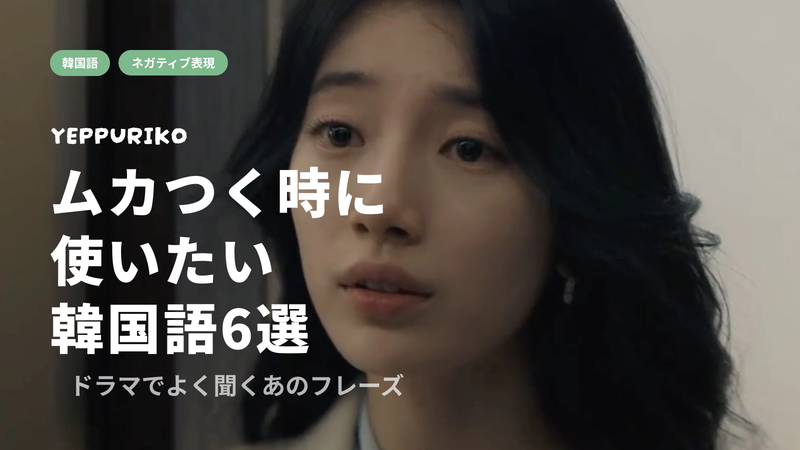
😤 A collection of expressions for anger and irritation often heard in Korean dramas
Yeppuriko is your one-stop guide to Korea for enjoying Korean beauty, travel, and gourmet experiences with peace of mind.
🎬 Can you properly catch the “anger” phrases flying around in Korean dramas?
When watching Korean dramas, short phrases come one after another in scenes where the characters become emotional, don’t they?
Have you ever wondered, “What does this mean?” while following the subtitles?
This time, we’ve picked out six Korean phrases expressing irritation, dissatisfaction, and anger that often appear in everyday conversation and Korean dramas.
We’ll explain their pronunciation in kana and the nuances as well, so challenge yourself to catch them while watching dramas.
Remember them as expressions used in conversations with friends or people your age.
😤 6 Korean Phrases You Can Use When You’re Annoyed

① 싫어!(シロ) → No way!
This is the simplest expression meaning “I don’t like it” or “I don’t want to.”
It is the conjugated form of the verb 싫다(シルタ), meaning “to dislike” or “to not want,” and conveys your feelings directly.
When said in a slightly spoiled or cutesy way, it can also have a heroine-like nuance from a drama.
② 짜증나!(ッチャジュンナ) → So annoying!
This is one of the emotional expressions you’ll hear very often in everyday Korean conversation.
짜증(ッチャジュン) means “irritation” or “annoyance,” while 나다 is a verb meaning “to arise.”
It’s useful to remember it as an expression that roughly corresponds to “This pisses me off” or “I’m annoyed” in Japanese.
③ 열 받아!(ヨル パダ) → This makes me furious!
열(ヨル) means “heat,” and 받다(パダ) means “to receive.”
Literally, it means “to receive heat,” but from the image of blood rushing to your head with anger, it expresses the feeling of “being furious” or “losing your temper.”
It is often used when you want to express slightly stronger anger than 짜증나.

④ 기분 나빠!(キブン ナッパ) → That’s unpleasant!
기분(キブン) is written with the Chinese characters for “mood,” while 나쁘다(ナップダ) is an adjective meaning “bad.”
Because it has almost the same structure as the Japanese expression “I feel bad,” it is easy to remember intuitively if you know the Chinese characters.
It is also similar to Japanese in that it describes an unpleasant emotional or mental state, rather than meaning that you are physically unwell.
⑤ 신경 쓰여!(シンギョン スヨ) → It bothers me!
신경(シンギョン) is written with the Chinese characters for “nerves,” while 쓰이다(スイダ) means “to be used” or “to be directed toward.”
It can be used both with the worried nuance of “I can’t stop thinking about it” and the irritated nuance of “It gets on my nerves.”
Since the meaning changes depending on the context, listening to the lines before and after it will deepen your understanding.
⑥ 마음에 안 들어!(マウメ アン ドゥロ) → I don’t like it!
마음(マウム) means “heart,” 들다(ドゥルダ) means “to enter,” and 안(アン) is a negative particle.
The structure is “doesn’t enter my heart” = “I don’t like it,” making it one of the expressions that is easy to translate literally into Japanese.
Use this expression when you feel that you don’t like a person, thing, or situation.
📝 Tips for Remembering These Phrases

✅ Pay attention to when you use them
All six expressions introduced here are casual colloquial expressions used in conversations with friends or people your age.
It is more natural to avoid using them with someone older or someone you are meeting for the first time.
Also, if you pay attention to the scenes in which these phrases appear in dramas, their natural intonation will be more likely to stick in your mind.
✅ Use them more naturally by choosing according to the level of anger
Mild dissatisfaction → 싫어 / 기분 나빠
Everyday irritation → 짜증나 / 신경 쓰여
Clear anger → 열 받아 / 마음에 안 들어
By paying attention to the strength of each expression, the lines in dramas may sound more vivid and nuanced.
✨ Summary: 6-Phrase Checklist
Finally, let’s review the phrases from this article.
- □ 싫어(シロ) ── Check whether you can say the simple “No way!”
- □ 짜증나(ッチャジュンナ) ── When you hear it in a drama, compare it with the subtitles
- □ 열 받아(ヨル パダ) ── Connect it with the image of its origin, “to receive heat”
- □ 기분 나빠(キブン ナッパ) ── Try to recall its meaning from the meaning of the Chinese characters
- □ 신경 쓰여(シンギョン スヨ) ── Remember that its nuance changes depending on the context
- □ 마음에 안 들어(マウメ アン ドゥロ) ── Remember its structure as “doesn’t enter my heart”
These are all expressions that often appear in everyday scenes in Korean dramas.
The moment you can understand them without subtitles, the fun of Korean dramas expands even more.
We brought you information from ‘イェプリコ’ to help you enjoy Korea more closely and with peace of mind.
At ‘イェプリコ’, discover trends and exciting moments that connect you with Korea.
Related Columns
- 4 medications for fever at midnight available at Korean convenience stores
- How to Choose a K-Drama So You’ll Never Again Wonder, “What Should I Watch Next?”
- 밥먹었어 Meaning: Why “Did You Eat?” Is a Korean Greeting
- The Korean remake film “Tonight, from the World” is trending on Netflix.
- A Complete Guide to Using “좋아요 (Joayo),” a Phrase You Always Hear in Korean Dramas
- Top 5 Korean Dramas of 2024 Chosen by Koreans✨