Under-Eye Fat: Remove It or Reposition It? — Why Korea Has the Answer

Why Korea has the answer【2026 Edition】
👁 Fat removal, the Hamra procedure, or a combined treatment—which one is right for you?

This is YEPPURIKO, your one-stop guide to enjoying Korean beauty, travel, and food with peace of mind.
🔍 The cause of looking “tired” may be under your eyes

For those concerned about puffiness and dark circles under the eyes, YEPPURIKO introduces the differences between two approaches attracting attention in Korea: fat removal and lower eyelid fat repositioning (the Hamra procedure).
“Accurately understanding your own condition” is the quickest path to satisfactory results.
In Korea, techniques have evolved beyond simply removing fat to include repositioning it to fill hollows, as well as combined approaches.
This article outlines the characteristics of fat removal and the Hamra procedure, the differences in who each is suitable for, and the trends in combined procedures becoming increasingly popular in Korea in 2026.
✂️ What Is Fat Removal? — A Simple Approach to Removing Under-Eye Bulges

Fat removal is a method of removing bulging fat through the conjunctiva on the inner side of the eye.
A key feature is that visible scarring is less likely, recovery is relatively quick, and the procedure tends to be short.
✅ Who Is Fat Removal Suitable For?
People whose under-eye fat is slightly bulging while their skin retains its elasticity. It is often considered for people in their 20s to 30s whose condition is relatively youthful.
However, removing fat may cause the under-eye area to become hollow, so it is important to have a doctor assess your condition (individual results may vary).
🔄 Lower Eyelid Fat Repositioning (Hamra Method) — The Concept of “Moving” Fat

The Hamra method (lower eyelid fat repositioning) is a technique that moves excess fat toward the hollowed tear trough area without removing it, smoothing and flattening the contour.
It is said to help smooth dark-circle shadows and grooves that are difficult to improve by removing fat alone, while supplementing volume.
✅ People Who May Be Considered for the Hamra Method
People with a relatively deep tear trough who are concerned about dark circles. It may also be recommended during a consultation for those who are worried that removing fat alone could make the under-eye area look sunken.
The procedure is divided into the transconjunctival Hamra method (an approach from the conjunctival side) and the external Hamra method (an incision from the skin side).
Which method is more suitable depends on the degree and condition of skin sagging, so a doctor’s assessment is necessary.
📋 Fat Removal vs. Fat Repositioning — Organized by Situation
It is not a matter of which is “better”; what is important is choosing the method that suits the condition of your under-eye area.
▶ Cases where fat removal is more commonly chosen
・The main concern is bulging fat under the eyes
・The tear trough line and deep dark circles are not particularly bothersome
・The skin’s elasticity is relatively well preserved
▶ Cases where fat repositioning (the Hamra method) is more commonly considered
・The tear trough line is deep, and dark circles are also a concern
・Worried that removing fat alone may cause hollowing
・The shadow beneath the lower eyelid bags has become deeper with age
✅ Key points for making a decision
“Is there too much fat?”, “Is the tear trough line deep?”, or “Is the skin lacking elasticity?” — by sorting out these three points during a pre-treatment consultation, you can determine which method is right for you.
🇰🇷 Trends in Korea in 2026 — Combination approaches are becoming more common
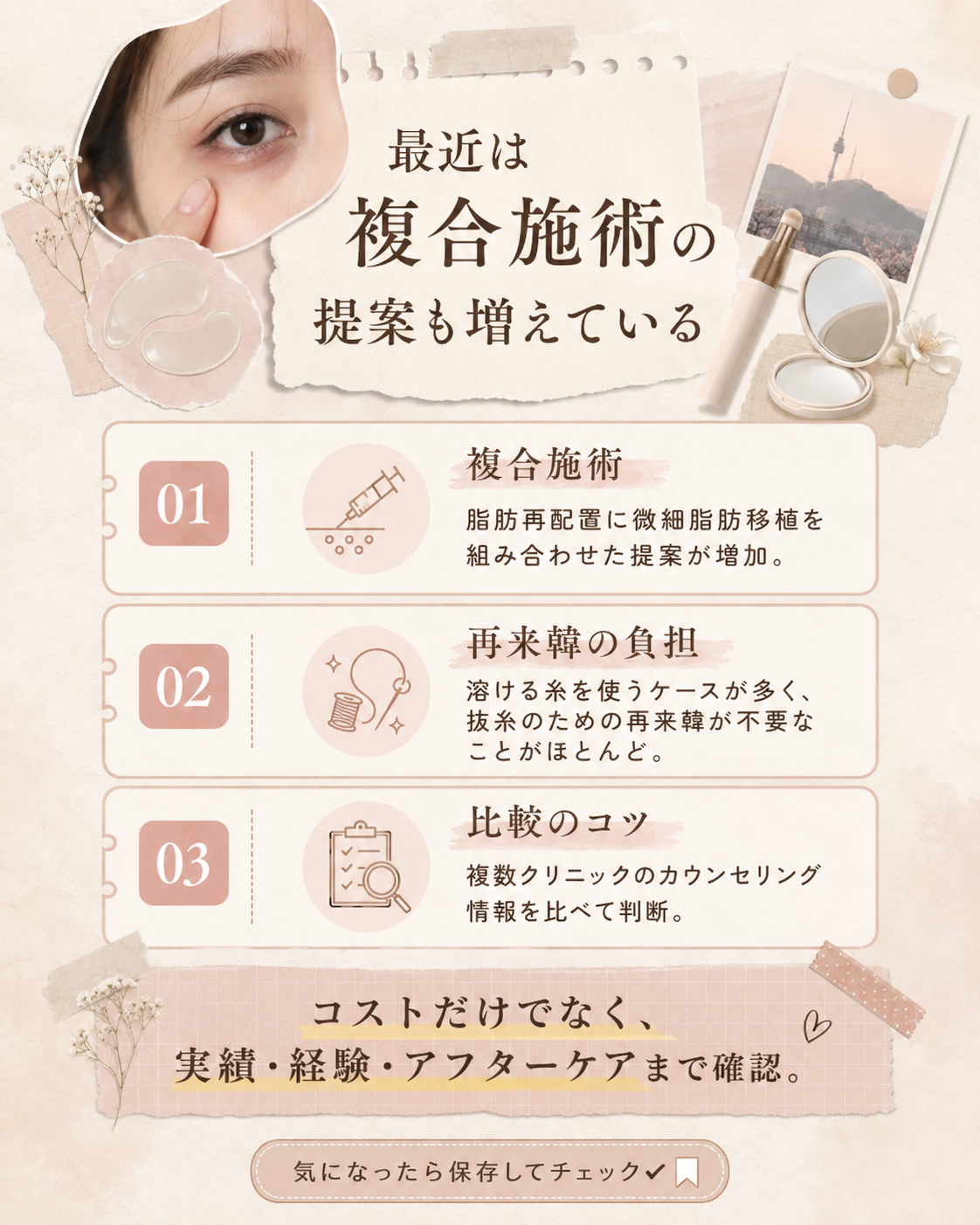
In Korean clinics in 2026, proposals combining fat repositioning with multiple other treatments are reportedly becoming more common.
▶ Commonly combined treatment examples
Fat Repositioning + Microfat Injection
This combination is expected to supplement the insufficient volume after repositioning with your own fat, resulting in a more natural appearance.
Combined with Thread Pumping(Thread Pumping)
If there is insufficient firmness under the eyes, it may be recommended as a method to enhance the effect of repositioning by lifting the area with dissolvable threads.
✅ Points to Note About Combined Procedures
Combined procedures are not mandatory. Whether they are necessary depends on your condition. During your consultation, it is important to ask the doctor “why the procedures are being combined” and make a decision only after you are satisfied with the explanation (individual differences may occur).
📌 Things to Check Before Traveling to Korea
✅ Things to Confirm During Your Consultation
・Whether fat removal or fat repositioning is more suitable for your condition
・If combined procedures are recommended, the reasons and purpose of each procedure
・Whether the procedure is a transconjunctival lower blepharoplasty or a transcutaneous lower blepharoplasty (this affects whether suture removal is required)
・The recovery period and when you can resume makeup and wearing contact lenses
・Whether any procedures may affect your return-home schedule
✅ Key Points Regarding Your Return-Home Schedule
In many cases, dissolvable sutures are used for the transconjunctival lower eyelid fat repositioning procedure (lower eyelid Hamra method) or fat removal, so returning home without a follow-up visit is generally possible. On the other hand, lower blepharoplasty involving a skin incision requires suture removal 5–7 days after surgery, so you need to pay attention to your travel schedule. Makeup is generally permitted 3–5 days after surgery, while contact lenses can typically be worn after one week (individual differences apply).
✅ Note on Public Holidays and Crowds
Clinics may be closed during Korean public holidays (such as Lunar New Year and Chuseok). If your trip to Korea falls before or after a public holiday period, it is reassuring to arrange your consultation, surgery, and follow-up examination schedule early.
✨ Summary — Pre-Trip Checklist for Korea
□ I have determined whether my concern is “puffiness” or “dark circles and hollows”
□ I understand the difference between fat removal and fat repositioning (the Hamra method)
□ I understand what to confirm if combination procedures are recommended
□ I plan to confirm the procedure method (transconjunctival Hamra / skin-incision Hamra) and whether suture removal is required in advance
□ I have confirmed whether suture removal and the recovery period will affect my return-home schedule
□ I have planned my schedule with the risk of clinic closures during public holidays in mind
□ I am prepared to ask questions during the consultation until I am satisfied
Even with the same procedure, the results can vary greatly depending on whether it suits your condition. Before coming to Korea, organizing your understanding of the condition under your eyes is the first step toward achieving satisfying results (individual differences apply).
We have brought you reliable Korean information that makes Korea feel closer and gives you peace of mind, from Yeppuriko.
Related Columns
- Korean Makeup Experience: Typical Prices and How to Book Right
- The Perfect Myeongdong & Anguk Beauty 1-Day Course
- Do you believe the before-and-after photos from Korean clinics without question?
- A story about a Korean clinic visit where the budget tripled by the time I got back
- Logical Negotiation Techniques for Getting a Correction at a Korean Clinic
- Question Photos That Are “Too Beautiful”: 3 Ways to Spot Fake Reviews and Edited Photos in Korean Beauty Content