Question Photos That Are “Too Beautiful”: 3 Ways to Spot Fake Reviews and Edited Photos in Korean Beauty Content
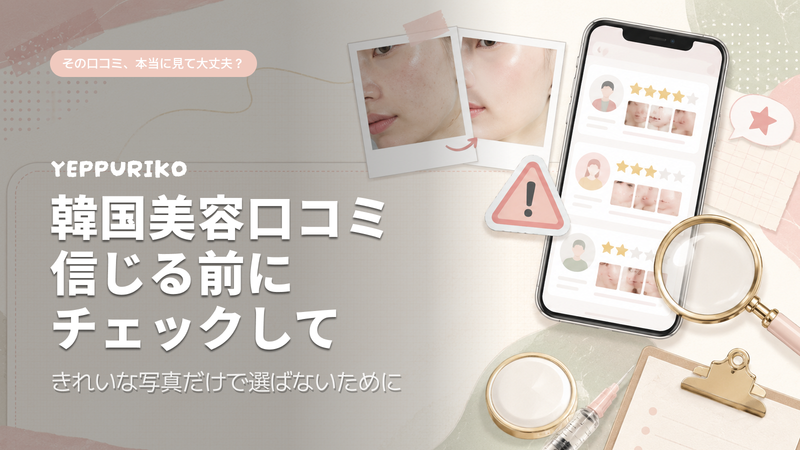
How to spot reviews and edited photos in Korean beauty
🔍 Guide to telling real results photos and reviews apart

This is イェプリコ, your one-stop guide to Korea, where you can enjoy Korean beauty, travel, and food with peace of mind.
📋 Contents
① Why are “too-perfect results photos” dangerous?
② Why should you be suspicious of “five-star, perfect-score” reviews?
③ Is someone who “kindly gives advice” on social media really being kind?
④ How to Gather Reliable Information
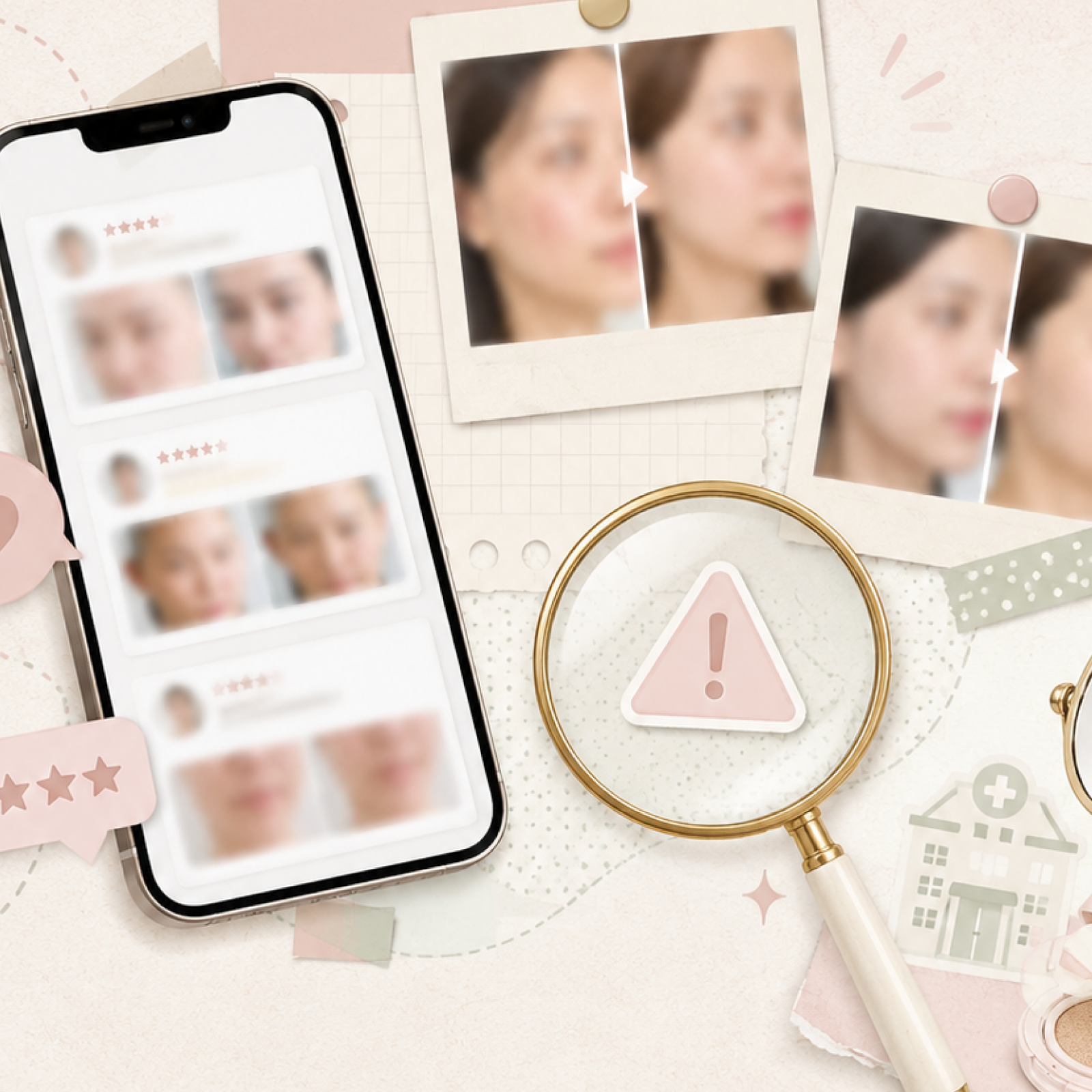
What should you really be careful about when choosing a beauty clinic in Korea?
Is it the number of negative reviews?
In fact, there are cases where clinics with “no negative reviews to be found anywhere” should be viewed with even greater caution.
make your decision based on the “line” of multiple progress reports.
That is the perspective you need to avoid regret when getting beauty treatments in Korea.
This article organizes specific methods for distinguishing edited photos from manipulated reviews.
📸 ① Why “too-perfect before-and-after photos” can be dangerous

The Before & After photos officially posted by clinics feature only cases with favorable results.
When additional editing is applied, they can end up looking significantly different from the actual treatment results.
There are three main points to check when identifying edited photos.
✅ 3 points to check for edited photos
① Distorted backgrounds When the facial contours are edited excessively, the lines of walls and doors in the background become unnaturally curved.
② Skin texture Photos with skin so smooth that pores are completely invisible may have been edited with a filter.
③ Around the ears When the jawline is edited, the shape and position of the ears are where mistakes are most likely to appear.
Meanwhile, more and more trustworthy clinics are intentionally publishing high-resolution photos in which even the pores are visible.
Posting “not-too-perfect photos” is also becoming a sign of credibility.
⭐ ② Why You Should Question “Five-Star, Perfect-Score” Reviews
A rating filled with perfect scores does not necessarily mean it is highly reliable.
Among the accounts shared by people who have traveled to Korea, there have been cases where they were instructed to “post a positive review” or asked to write specific content.
In addition, at clinics where you can receive a discount for writing a review, ratings tend to be generally more lenient.
✅ How to Identify Reliable Reviews
△ Reviews to Be Cautious About Short and abstract reviews such as “The doctor was kind” or “The results were amazing.”
◎ Reviews Worth Referring To Reviews that specifically describe the recovery process and drawbacks, such as “The swelling was about this severe on day 〇” or “Waking up from anesthesia was difficult.”
We recommend reading the content of the review rather than focusing on the number of stars.
📱 ③ Is Someone Who “Kindly Gives Advice” on Social Media Really Being Kind?
When you come across an account enthusiastically recommending a specific clinic on social media, consider the possibility that it may be advertising (PR).
There are three points to look for.
① Go through past posts
Accounts that mix posts about other clinics with everyday posts are more likely to belong to general users.
Be cautious of accounts that direct you to the same clinic regardless of the topic.
② Check how they respond to DMs
Be cautious if they appear to provide information courteously but pressure you to hurry with reservation assistance or agent registration.
③ Are they directing everyone to just one clinic?
Accounts that recommend only one specific clinic without comparing multiple clinics may be PR accounts.
🔎 ④ How to gather reliable information

Gathering information in places without conflicts of interest is effective for avoiding edited or manipulated information.
Make use of LINE open chats
In open chats within communities for people traveling to Korea, users share their genuine experiences with one another in real time.
They are places where honest opinions such as “The service was poor” and “The consultation was thorough” are likely to be shared.
Use negative searches
Try searching for words such as “failure,” “side effects,” and “revision” together with the clinic name.
Looking at how the clinic responds to negative information can give you some idea of its integrity.
✅ Your “intuition” during the consultation is also important
The discomfort you feel during an actual consultation may be more accurate than reviews or photo ratings.
💬 ⑤ What to confirm during your advance consultation

✅ What to prepare before your consultation
・Research basic information about the procedure you are interested in beforehand (details of the procedure and estimated downtime)
・Ask directly, “What happens if the procedure does not go as expected?”
・Have consultations at multiple clinics and compare the thoroughness of their explanations and their responses
・Also confirm the follow-up system after the procedure
There is no single right answer when choosing a clinic, but the attitude of “checking information from multiple angles” can help reduce regret.
✨ Summary
Let’s review the key points of this article with a checklist.
☑ For before-and-after photos, check these three points: “background distortion, skin texture, and the area around the ears”
☑ Don’t focus on the number of stars in reviews; read to see whether they mention the recovery process and disadvantages
☑ For SNS accounts, check past posts, where they lead you, and how they respond to DMs
☑ Gather information in communities with no conflicts of interest, such as LINE Open Chat
☑ Search using negative keywords to see how the clinic responds
☑ Treat any discomfort you feel on the day of the consultation as one factor in your decision
Related Columns
- Korean Makeup Experience: Typical Prices and How to Book Right
- The Perfect Myeongdong & Anguk Beauty 1-Day Course
- Do you believe the before-and-after photos from Korean clinics without question?
- A story about a Korean clinic visit where the budget tripled by the time I got back
- Logical Negotiation Techniques for Getting a Correction at a Korean Clinic
- Under-Eye Fat: Remove It or Reposition It? — Why Korea Has the Answer