Titanium Lifting vs Onda Lifting: Which One Fits You?
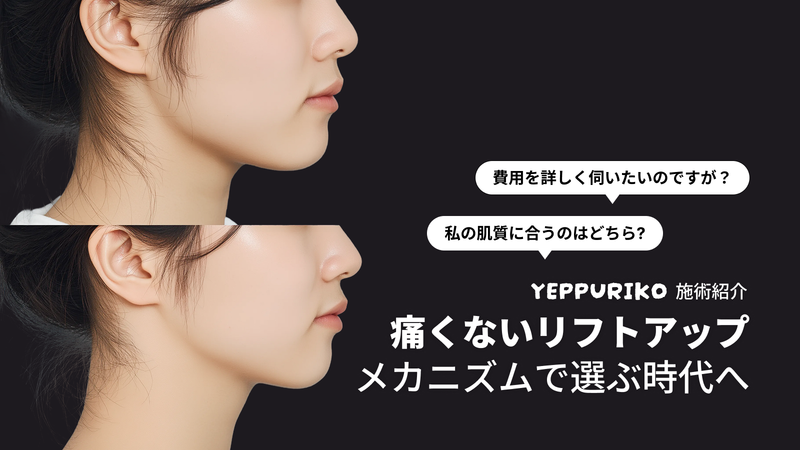

Titanium lifting and Onda lifting are the two most talked-about non-surgical lifting treatments at Korean clinics right now, and while their names sound similar, their mechanisms are completely different. Titanium lifting uses a three-wavelength laser to tighten the entire face and brighten skin tone, while Onda lifting uses microwaves to break down fat cells while lifting the skin. If you've been searching "titanium lifting vs onda lifting" trying to figure out which one matches your concerns, this guide breaks down exactly how each one works, who it's best for, and whether combining both makes sense for you.
Both treatments require no surgery, involve little to no pain, and come with minimal downtime — which is exactly why they've become popular with visitors combining a beauty procedure with a Korea trip. But choosing between them isn't about which is "better." It's about which problem you actually want solved.
Quick answer: choose Titanium lifting if your main concern is overall skin tightening, dullness, and pores. Choose Onda lifting if your main concern is a double chin, jawline fat, or facial contour. Many clinics in Korea offer both on the same day.
What exactly is a "lifting treatment"?
As we age, concerns such as sagging cheeks and jawlines and more noticeable nasolabial folds start to appear. Lifting treatments are cosmetic procedures designed to improve this kind of sagging and gently lift the entire face without surgery.

Recently, "non-surgical lifting" has become the mainstream approach, with methods using lasers, ultrasound, and radiofrequency to target the skin from within. Common examples include HIFU, Thermacool, and thread lifts — but among all of these, the two treatments currently generating the most buzz in Korea are Titanium lifting and Onda lifting. Although their names sound somewhat similar, their approaches are completely different, so it's worth understanding each one before booking.
Titanium lifting: a laser treatment that tightens and brightens the whole face

Titanium lifting applies the technology of the "Soprano Titanium" laser device, originally developed for medical hair removal. Its biggest feature is that it emits three different wavelengths — 755nm, 810nm, and 1064nm — simultaneously. It delivers thermal energy evenly from the superficial to deep layers of the skin, down to around the SMAS fascia, tightening the entire skin at once.
Roles of the three wavelengths
| Wavelength | Role |
|---|---|
| 755nm | Reacts with melanin pigments to improve dullness and brighten skin tone |
| 810nm | Promotes collagen and elastin production in the dermis |
| 1064nm | Reaches the deep SMAS fascia layer for firm lifting |
Because it addresses so many concerns with a single treatment, it's sometimes called a "party lift" in Korea — apparently many people book it on the day of an important event because the downtime is minimal and effects show up almost immediately.
Titanium lifting at a glance
- Treatment time: approximately 30 minutes (full face)
- Pain: almost none (a cooling system protects the skin's surface at -3°C)
- Downtime: almost none — makeup is allowed immediately afterward
- Immediate effects: a lifting effect can be felt right after treatment
- Duration: approximately 3–6 months
- Recommended frequency: monthly maintenance is ideal
Titanium lifting is recommended for those concerned about nasolabial folds or sagging cheeks, anyone who wants to brighten overall facial tone, people who want to address pores and dullness at the same time, and those sensitive to pain who prefer zero downtime.
Onda lifting: a microwave treatment that targets fat directly
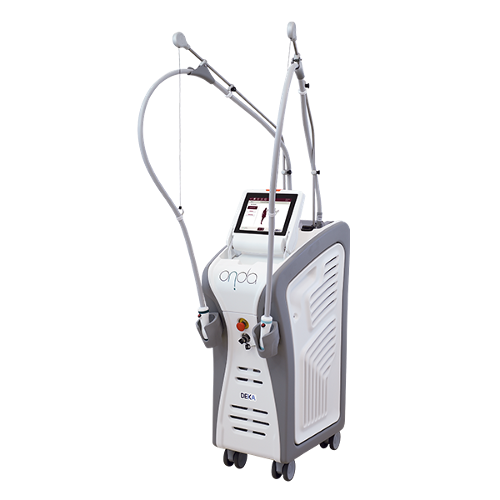
Onda lifting uses the "ONDA PRO" device developed by the Italian company DEKA. Its defining feature is a patented microwave technology called Coolwaves®, which delivers thermal energy precisely to the fat layer without damaging the skin's surface. In other words, it's a treatment that can lift the skin while breaking down fat cells in areas of concern.
The two handpieces, explained
| Handpiece | Target |
|---|---|
| 3mm | Dermal layer — promotes collagen contraction and production to improve firmness |
| 7mm | Subcutaneous fat layer — heat stimulation reduces fat and tightens skin |
The biggest appeal of Onda lifting is that it can break down fat cells directly. Because damaged fat cells are gradually eliminated from the body as waste, it's also less likely to cause rebound weight gain compared to some other treatments. It's especially recommended for those concerned about double chins or fat around the jawline. The microwave heat also promotes collagen production, so improvements in firmness and texture can be expected too. The handpiece includes a cooling function that protects the skin during treatment, so anesthesia isn't necessary.
Onda lifting at a glance
- Treatment time: approximately 15–30 minutes
- Pain: almost none (cooling function; no anesthesia required)
- Downtime: almost none — makeup is allowed immediately afterward
- Immediate effects: a tightening sensation is noticeable right after; peaks in 1–3 months
- Duration: approximately 3–6 months, potentially up to about 1 year after 3 sessions
- Recommended frequency: once a month × 3 sessions is best
Onda lifting is recommended for those concerned about double chins or cheek fat, anyone who wants to eliminate sagging along the jawline, people who want to reduce fat while also caring for sagging skin, and those who are sensitive to pain but want noticeable results.
Titanium lifting vs Onda lifting: a side-by-side comparison
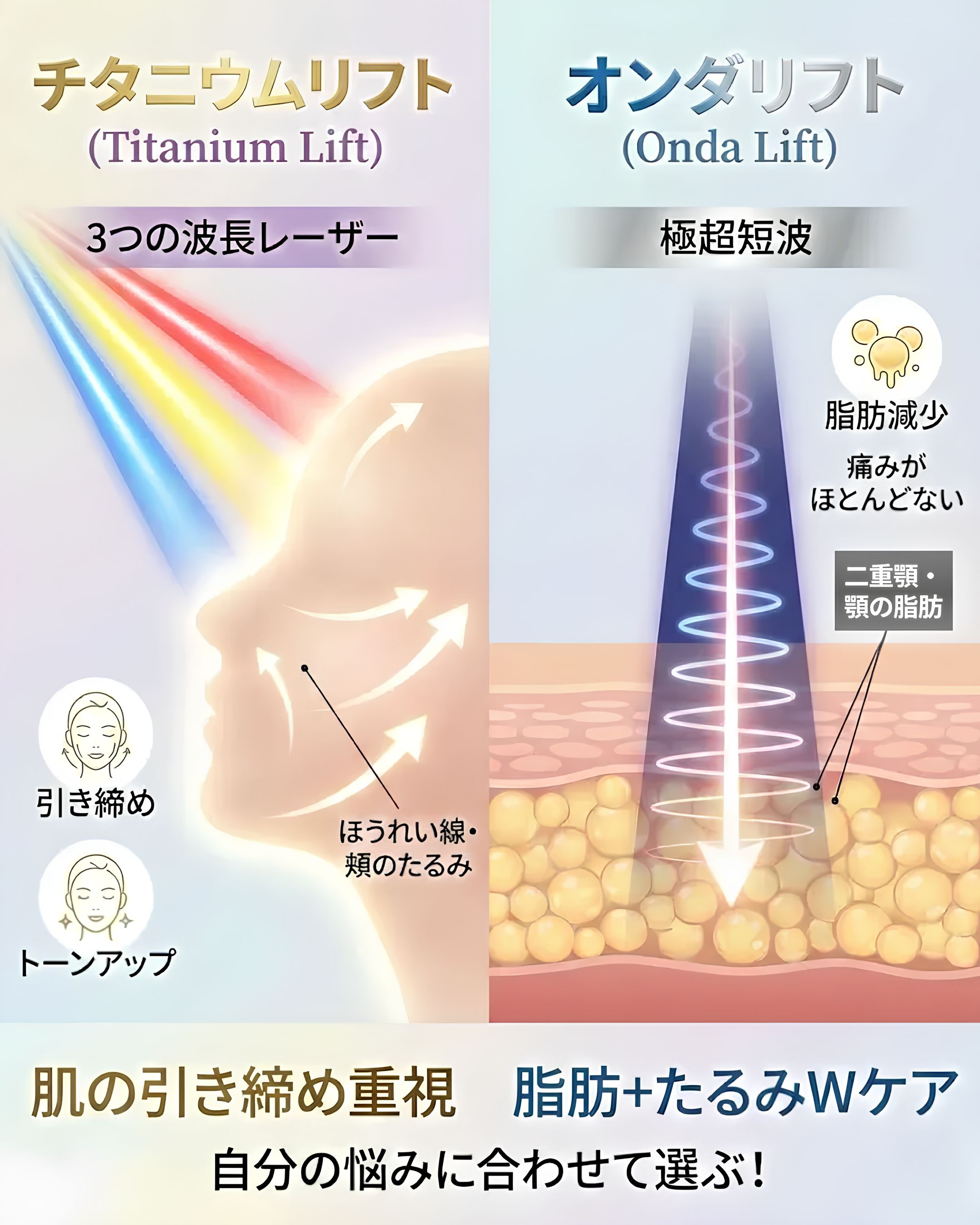
Even though both are marketed as "lifting treatments," the energy used and the approach taken are quite different, as this table shows.
| Item | Titanium Lifting | Onda Lifting |
|---|---|---|
| Energy used | 3-wavelength laser (755nm, 810nm, 1064nm) | Microwaves (Coolwaves® 2.45GHz) |
| Main targets | Epidermis–dermis–SMAS fascia (entire skin) | Dermal layer–subcutaneous fat (fat-focused) |
| Main effects | Lifting, tightening, brightening, pore care | Fat reduction, lifting, collagen regeneration |
| Pain | Almost none | Almost none |
| Treatment time | Approx. 30 minutes | Approx. 15–30 minutes |
| Downtime | Almost none | Almost none |
| When effects show | Immediately, further improvement after 3 weeks | Immediately, peaks in 1–3 months |
| Duration | Approx. 3–6 months | Approx. 3 months–1 year |
| Approach to fat | None | Yes (destroys fat cells) |
| Brightening effect | Yes | None |
In a nutshell: Titanium is the "all-around skin-beautifying treatment" for overall tightening plus a brighter complexion. Onda is the "contour-focused treatment" for fat reduction plus sagging care.
How to choose based on your concern
If you're still wondering which one fits you, try choosing based on your specific concern rather than which treatment sounds more advanced.
Titanium lifting is recommended if you...
Are concerned about nasolabial folds or sagging cheeks, want to care for dullness and skin tone at the same time, want to address enlarged pores or fine lines, are new to aesthetic treatments and want something easy to start with, or want a targeted tightening treatment before an event.
Onda lifting is recommended if you...
Are concerned about a double chin or fat around the facial contour, want to reduce facial fat for a more defined look, want to address both fat and sagging at once, have experienced hollowed cheeks after HIFU, or want contour care that's less likely to result in rebound.
Combining both is also an option
An increasing number of people at clinics in Korea are getting Titanium lifting and Onda lifting together. It's a "best of both worlds" combination: tightening the entire skin with Titanium while targeting fat and sagging with Onda. Because they work through different mechanisms, many clinics offer both treatments on the same day.
What to expect: treatment process and downtime
The treatment process for both Titanium lifting and Onda lifting is straightforward.
- Consultation — discussing your skin condition and concerns
- Cleansing to keep the skin clean before treatment
- Applying gel and starting the treatment
- Wiping off the gel to finish
- Makeup can be applied immediately afterward
Many people describe both treatments as feeling "like a warm massage." With Titanium lifting, you feel the warmth of the laser light, while Onda lifting feels like the skin's surface stays cool while the inside gradually warms up.
Downtime and precautions
Both treatments involve little to no downtime. You may notice slight redness or warmth right after treatment, but it generally subsides within a few hours to a day. That's the biggest appeal for travelers — you can get the treatment during a Korea trip and go straight to sightseeing or shopping afterward.
Post-treatment precautions to keep in mind: moisturize thoroughly, avoid harsh skincare like scrub cleansers for one week, avoid saunas and alcohol for about a week, protect the skin from UV rays, and avoid rubbing or otherwise irritating the treated area.
Key takeaways
Titanium lifting is the pick for overall skin tightening, brightening, and pore care in one session. Onda lifting is the pick for double chins, jawline fat, and contour-focused sagging care. Both are low-pain, low-downtime treatments suited to first-timers, and many clinics allow both on the same day if you want combined results.
FAQ
What is the difference between Titanium lifting and HIFU?
HIFU delivers energy to a concentrated point using ultrasound, while Titanium lifting gently targets a wide area using a laser. Because HIFU can affect the fat layer, there's a risk of hollowing in the cheeks, whereas Titanium lifting involves less tissue impact and significantly less pain.
Is Onda lifting really painless?
Because the handpiece's cooling system works effectively during treatment, you'll feel little to no pain. It feels like a warm massage, so even first-timers trying a lifting treatment can feel at ease.
Titanium lifting vs Onda lifting — how often should I get each treatment?
For both treatments, around three sessions once a month is the general guideline. After that, maintenance sessions once every 3–6 months are recommended to sustain results.
Can I get both Titanium and Onda lifting on the same day?
Since their mechanisms differ, many clinics in Korea offer both treatments on the same day, and more visitors are combining them during a single trip. That said, depending on your skin condition it may be better to space out treatments, so discuss this during your consultation.
How long do the effects of Titanium and Onda lifting last?
Titanium lifting typically lasts approximately 3–6 months, while Onda lifting may last up to about one year after three sessions. Results and duration vary from person to person, so regular maintenance is important to sustain the effect.
Related Columns
- Korean Makeup Experience: Typical Prices and How to Book Right
- The Perfect Myeongdong & Anguk Beauty 1-Day Course
- Do you believe the before-and-after photos from Korean clinics without question?
- A story about a Korean clinic visit where the budget tripled by the time I got back
- Logical Negotiation Techniques for Getting a Correction at a Korean Clinic
- Question Photos That Are “Too Beautiful”: 3 Ways to Spot Fake Reviews and Edited Photos in Korean Beauty Content