Complete Guide to Korean Cuisine | Classic Dishes to Enjoy with Confidence Even on Your First Trip
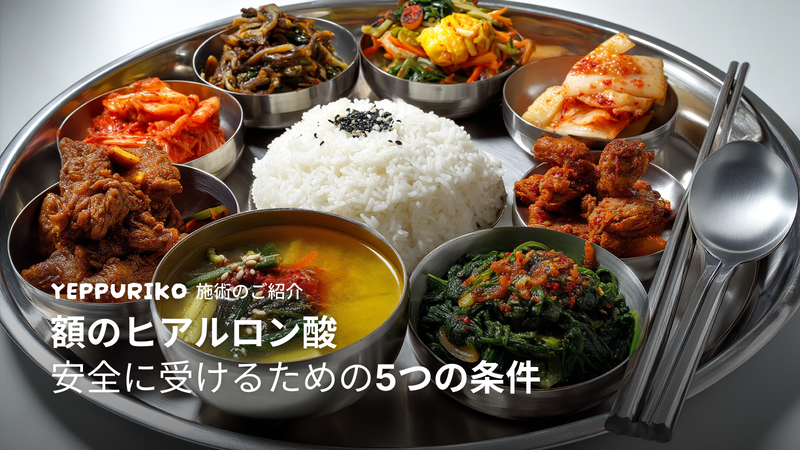

Are you unsure what to eat on your first trip to Korea?
One of the best parts of traveling to Korea is, of course, the food.
That said, we often hear people say, “There are just too many options, and I ultimately don’t know what to choose…”
So this time, we’ll provide an easy-to-understand guide covering everything from classic dishes you can’t go wrong with, even as a first-timer to 2025’s trending gourmet foods.
We’ll also introduce Korean food culture and etiquette that will make your trip even more comfortable when you know about them.
After reading this article, your next trip to Korea is sure to be even more delicious and enjoyable✨

🍽️ 5 Must-Try Korean Dishes to Start With!
If you're not sure what to eat on your trip to Korea, you can rest assured if you start with these five.
Every one of them is a classic Korean dish that's easy to choose even for first-timers.
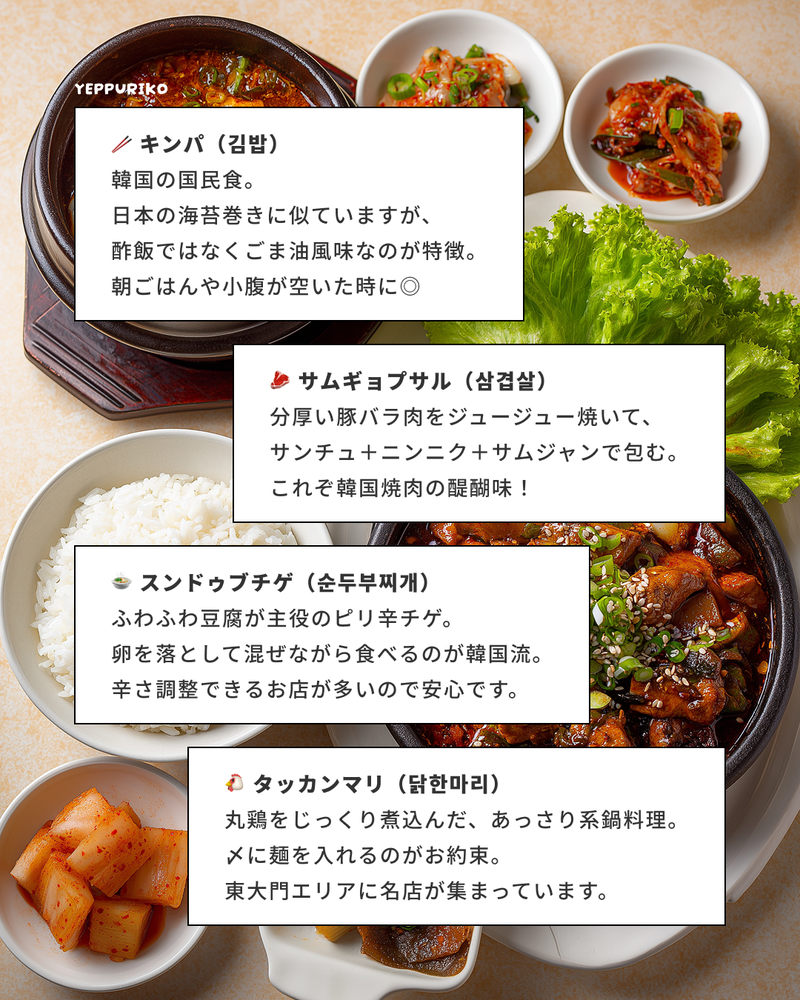
🥢 Gimbap(김밥)
When it comes to Korea's national dish, it has to be gimbap.
It's similar to Japanese sushi rolls, but instead of vinegared rice, it is characterized by being seasoned with sesame oil.
Its subtly savory aroma makes it irresistibly delicious.
It's perfect for breakfast or when you want a light snack, and you can easily buy it all over Korea.
Since it's also available at convenience stores, it's a great snack to enjoy during your trip.
🥩 Samgyeopsal(삼겹살)
Samgyeopsal is the very symbol of Korean barbecue.
Grill thick slices of pork belly until sizzling, then wrap them in lettuce with garlic and ssamjang (soybean paste sauce)—
This is the true essence of Korean barbecue!
The classic Korean travel itinerary of toasting with barbecue at night is simply not to be missed.
The thickness of the meat and the side dishes vary by restaurant, which is part of the appeal—you'll never get tired of eating it, no matter how many times you do.
🥞 Korean Pancake(전)
Jeon, also known as Korean-style okonomiyaki.
The crispy outside and chewy, soft inside are simply irresistible.
In Korea, there's a saying, “On rainy days, eat jeon and makgeolli,” because it's such a classic dish that you can't help craving on rainy days.
There are many varieties, including green onion, seafood, and kimchi jeon, making them the perfect accompaniment to drinks.
🍲 Sundubu-jjigae(순두부찌개)
A mildly spicy stew featuring soft, fluffy tofu.
It's a comforting dish that warms you from the inside on cold days and is an essential soul food during Korean winters.
The Korean way to enjoy it is to drop in an egg and eat it while stirring.
Many restaurants let you adjust the spice level, so even those who don't like spicy food can enjoy trying it without worry.
It pairs perfectly with white rice and is so delicious that you'll want to ask for seconds.
🐔 Dakhanmari(닭한마리)
A light hot pot dish made by slowly simmering a whole chicken.
The rich flavor of the chicken is concentrated in the broth, creating a deeply satisfying taste.
It's customary to add noodles at the end, so you can enjoy it down to the very last drop.
Many famous restaurants are concentrated in the Dongdaemun area, so it's a great place to stop by while shopping.
🔥 2025 Trend! Popular Foods Making Waves in Korea Right Now
Classic dishes are great, but if you're making the trip, you may want to experience what's happening locally “right now.”
Here are some of the hottest foods of 2025 that we recommend.
🐙 Nakgopsae(낙곱새)
Have you heard of “nakgopsae”?
It's a luxurious hot pot dish made by simmering octopus(낙지), intestines(곱창), and shrimp(새우)in a sweet and spicy sauce, and it's also a popular menu item in Seoul.
Tender octopus, bouncy intestines, plump shrimp…
You can enjoy a variety of textures all at once, while the sweet and spicy sauce pairs perfectly with both rice and drinks.
For the finale, the Korean way to enjoy it is to add rice and make bokkeumbap (fried rice).
🥯 Korean-Style Bagels
They have an incredibly chewy texture and a deliciousness that differs from Japanese bagels.
Korean-style bagels are crispy on the outside and fluffy and chewy on the inside, and more and more people are becoming hooked after trying them once.
Bagel specialty shops in Seoul are so popular that long lines are practically guaranteed.
There is also a wide variety of toppings, including cream cheese and red bean butter.
If you enjoy café hopping, be sure to check them out.
🇰🇷 Useful to Know! Korean Food Culture

One interesting difference between Korean and Japanese food culture is the presence of “side dishes” (반찬/banchan).
In Korea, when you order a meal, generally around 5 to 10 types of side dishes are often provided free of charge.
Kimchi, namul, bean sprouts, braised potatoes, Korean seaweed…
The table fills up with a lineup that alone is enough to make you want more rice.
What's more, many restaurants offer free refills.
At first, you may be surprised and think, “But I didn't order all this…!”—but this is Korean-style hospitality. Once you get used to it, it becomes addictive.
📝 Useful Points to Remember
✓ Side dishes(반찬)are free and many restaurants offer unlimited refills
✓ The standard is often to share dishes with several people rather than dine alone
✓ If you want less spice, just say “덜 맵게(トルメッケ)”
❓ Frequently Asked Questions (FAQ)
Q. Can I order even if I don’t speak Korean?
A. Many restaurants in tourist areas have Japanese menus.
There are also many menus with photos, so pointing at what you want is perfectly fine.
Translation apps have also become very convenient, so you can feel at ease as long as you have your smartphone.
Q. Can I enjoy Korean cuisine by myself?
A. Of course you can.
Many dishes, such as gimbap and sundubu-jjigae, can be ordered as a single serving.
However, many restaurants generally require orders for at least two servings of samgyeopsal and dakhanmari, so it’s best to check in advance.
Q. Is it okay if I don’t like spicy food?
A. Of course.
Although Korean food is often associated with spiciness, there are also plenty of non-spicy dishes, such as gimbap and dakhanmari.
Many restaurants can adjust the level of spiciness, so try saying “안 맵게 해주세요(アンメッケ ヘジュセヨ)=Please make it non-spicy.”
✨ Summary
What did you think of these must-try foods for your trip to Korea?
From classics like gimbap and samgyeopsal to 2025 trends like nakgopsae and Korean-style bagels.
Korea is full of delicious food.
We hope you’ll use this as a reference for your next trip to Korea💕
We’ve brought you reliable Korean information from 『イェプリコ』 to help you feel closer to Korea with peace of mind.
Related Columns
- Perilla Dishes in Seoul: The Definitive Guide to 6 Top Restaurants
- The Korean dessert you break apart to eat is today's right answer
- 5 Must-Try Specialty Shops for Korean Bingsu (Shaved Ice)
- A Hidden Gem in Anguk: “Jinjaku Kaki” — A New Korean-Japanese Fusion Experience
- Korea 【The World of the Married Filming Location】 Michelin-trained near Gwanghwamun Station
- 【Pumasi (품앗이)】A night in Korea calls for tofu kimchi and makgeolli.