Best 8 Korean Winter Street Foods The colder it gets, the more delicious they are!


Why piping-hot snacks taste even better below freezing✨
From Korean beauty, travel, and gourmet experiences
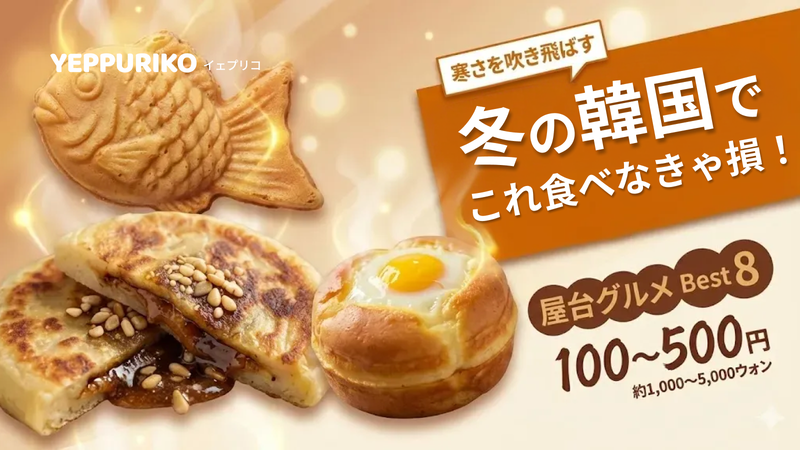
❄️ Even better because it’s cold! Why Korean winter street-food delights are absolutely worth trying
“I was thinking of skipping Korea in winter because it’s just too cold…”
If that sounds like you, wait a minute!
That would actually be such a shame.
Korean winters are certainly cold.
Days when temperatures drop below freezing are not uncommon.
But it’s precisely because of that cold
that street food tastes surprisingly delicious✨
When you walk through Myeongdong’s street-food district,
the fragrant aroma of roasted chestnuts,
the sweet smell of hotteok,
the comforting aroma of eomuk broth that warms you from within……
The steam rising into the cold air,
and the warmth you feel in the palms of your hands.
This is exactly what makes winter in Korea so special💕
This time,
we’re introducing the Best 8 Korean winter street foods you absolutely must try!
・Where can you buy them?
・How do you order them?
・How are they different from Japanese street food?
So that even first-time visitors can enjoy them with confidence,
we’ll explain everything thoroughly and clearly〜🔥
🐟 ① 붕어빵(Bungeoppang)|Is Korea’s version of taiyaki actually a crucian carp pastry?

When it comes to classic Korean winter street food, bungeoppang is a must!
It looks just like Japanese taiyaki, but 붕어(bungeo)actually means “crucian carp.”
So, strictly speaking, it’s a “crucian carp pastry”😂
How it differs from Japanese taiyaki
Japanese taiyaki
・The batter is fluffy and chewy ・The shell is relatively thick ・Packed with red bean paste
Korean bungeoppang
・The shell is thin and crispy! ・The outside has a light, crunchy texture ・It contains plenty of red bean paste but has a light taste
This “crispy texture” is the biggest feature of Korean bungeoppang✨
Once you try it, you’re sure to become addicted!
Variety of flavors
Classic: Red bean paste (팥)
Korean red bean paste is less sweet than the Japanese version.
It pairs perfectly with the crispy shell, so you can easily eat several💕
Popular: Custard cream (슈크림)
This type is filled with smooth, sweet custard.
It’s extremely popular among younger generations.
Other creative varieties
・Chocolate ・Cheese ・Sweet potato cream
Recently, more and more creative varieties of bungeoppang have been appearing,
and it’s fun because each street stall has its own unique offerings〜!
Special winter-only appeal
Bungeoppang is basically a “winter-only dessert”!
You’ll only see it from around November to March, so you won’t find it even if you visit Korea in summer.
That’s precisely why its seasonal availability makes it taste even more special.
If you spot some at a street stall, we highly recommend buying it right away without hesitation✨
🥞 ② Hotteok(ホットク)|A classic winter dessert with molasses and nut filling that melts in your mouth

When it comes to Korean winter street food desserts, hotteok is an absolute must!
You simply can't talk about winter in Korea without it💕
What is hotteok?
Hotteok is a snack made by filling wheat flour dough with
a syrup made from molasses, nuts, cinnamon, and more,
then grilling it flat on a hot plate.
When you eat it fresh off the grill, the syrup oozes out from inside, and it's simply amazing✨
Outside: Crispy, fragrant deliciousness
Inside: Soft and chewy dough
Center: Piping-hot, sweet syrup
These three layers of texture create an irresistible deliciousness🔥
Be careful not to burn yourself! But that's part of the fun
The most important thing to watch out for with hotteok is that it's “scorching hot”!
The syrup inside is truly extremely hot,
so if you bite into it too enthusiastically, you'll definitely burn yourself😂
But the contrast between the “cold outdoor air” and “piping-hot hotteok”
is what makes it such a uniquely enjoyable part of winter in Korea.
Please experience the happiness of eating it while blowing on it to cool it down💕
An ever-growing variety of hotteok
In Korea these days, besides the traditional brown sugar hotteok,
a wide variety of options are appearing!
Vegetable hotteok
A savory hotteok filled with cabbage, carrots, glass noodles, and more.
Also recommended for those who don't like sweets.
Cheese hotteok
A hugely popular type among young people, filled with gooey cheese.
Perfect for social media photos✨
Red bean hotteok
A Japanese-style variation filled with sweet red bean paste.
A flavor that is familiar and appealing to Japanese people, too.
Oreo hotteok
A highly eye-catching dessert-style hotteok with a whole Oreo cookie inside.
Extremely popular among younger generations!
How to identify a delicious hotteok stall
“Where can I find delicious hotteok?”
Koreans answer that question like this:
“A stall with Koreans lining up is guaranteed to be delicious!”
If you find a stall with locals lining up,
don't hesitate to join the line.
You’re unlikely to be disappointed✨
🥚 ③ 계란빵 (Gyeran-ppang)|A unique bread with a whole egg inside!
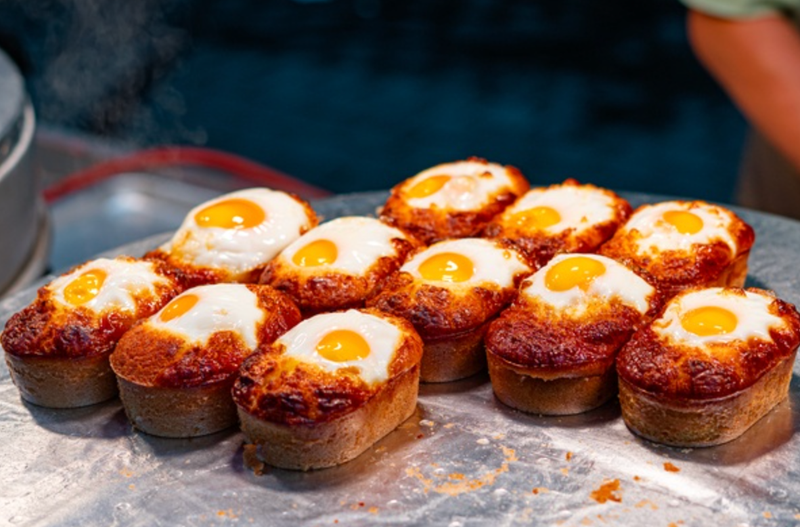
「계란(Gyeran)」 means “egg” in Korean,
while 「빵(Ppang)」 simply means “bread.”
In other words, it’s “egg bread,”
but it’s a unique and addictive street food that you won’t find in Japan!
What kind of food is gyeran-ppang?
A round, cupcake-like bread served in a paper cup.
And there’s one whole egg right in the middle!
The bread dough has a sweetness similar to a pancake,
and is fluffy and moist.
With a soft-boiled egg inside,
it has a wonderfully sweet-and-savory flavor✨
Perfect for breakfast or a light snack
Since gyeran-ppang isn’t overly sweet, many Koreans enjoy it as a breakfast substitute.
The egg also makes it nutritious,
and since you can eat it with one hand, it’s perfect for enjoying on the go💕
On a winter morning, when you’re feeling a little hungry,
buying some warm gyeran-ppang and eating it as you stroll along…
That’s one of the pleasures of traveling in Korea during winter〜!
Innovative versions are also appearing
Cheese-filled gyeranppang has also been popular lately!
The combination of gooey cheese and egg makes it even more delicious🧀
🍢 ④ Eomuk(Omuk)|How Korean-style oden is so different from Japanese oden!

Eomuk is often called “Korean oden” by Japanese people.
But in reality, it’s quite different from Japanese oden!
What makes eomuk special
Eomuk is
fish paste products made from ground fish, threaded onto long skewers,
and simmered in a light soup made with daikon radish and dried anchovies—a popular street food.
And this soup…
is truly delicious✨
Differences from Japanese oden
Japanese oden
- A wide variety of ingredients (daikon radish, konjac, eggs, etc.)
- Rich, deeply flavored broth
- Simmered slowly in a pot
Korean eomuk
- Basically just fish paste products
- Clear, light soup
- Served on skewers
- Free unlimited refills of the broth!
This “unlimited broth” is
the greatest appeal of Korean eomuk💕
On a cold winter day,
when you gulp down the piping-hot broth…
it warms you up from the core of your body🔥
Unique Ways to Eat and Order
Korean eomuk stalls have
a unique self-service culture that you don’t often see in Japan.
① Take the skewers yourself
Choose your favorite eomuk skewers from the large pot and take them yourself.
② Dip them in soy sauce and eat
Dip the fish cakes on the skewers into the provided soy sauce and enjoy.
③ Gulp down the broth
Pour the broth into a paper cup and drink as much as you like (of course, it’s free!).
④ Report the number of skewers at the end
When you’re finished eating, tell the staff how many skewers you had and pay.
This “honor system”
really gives you a sense of Korea’s culture of trust, doesn’t it?✨
Busan Specialty: 물떡 (Multeok)
When you visit Busan, be sure to try “Multeok”!
It’s a version of eomuk soup
with chewy rice cakes added to it.
With the savory flavor of fish cakes combined with the chewy texture of rice cakes,
it’s irresistibly delicious💕
When traveling to Busan, this is a must-try food〜!
🍠 ⑤ 군고구마(Kungoguma)|Korean roasted sweet potatoes are different varieties!

「군(Kung)」means “to roast,” while 「고구마(Goguma)」means “sweet potato.”
In other words, they’re roasted sweet potatoes, but
Korean roasted sweet potatoes are different varieties from those in Japan✨
Korean Sweet Potato Varieties
When you visit a Korean supermarket or market,
you’ll find an incredible variety of sweet potatoes!
These are the two varieties you’ll often see at street stalls.
호박고구마(Hobakgoguma)
・Means “pumpkin sweet potato”
・Soft and creamy texture
・Rich sweetness
・Vibrant orange color
밤고구마(Bamgoguma)
・Means “chestnut sweet potato”
・Fluffy and starchy
・Refined sweetness
・Yellowish color
Many varieties are similar to Japan’s “Beni Haruka” and “Silk Sweet,”
and whichever one you choose, they’re all truly delicious💕
An unexpected way to eat them: roasted sweet potatoes × kimchi
When you ask Koreans how to enjoy roasted sweet potatoes,
you’ll often get an answer like this:
“Eat roasted sweet potatoes and kimchi together!”
You might think, “What?!” 😂
But this combination actually works incredibly well.
The combination of sweet sweet potatoes
and spicy, tangy kimchi creates an exquisite balance.
You’ll have to trust me,
but please give it a try at least once✨
🌰 ⑥ 군밤(Gungbam)|Fragrant roasted chestnuts are a classic winter snack
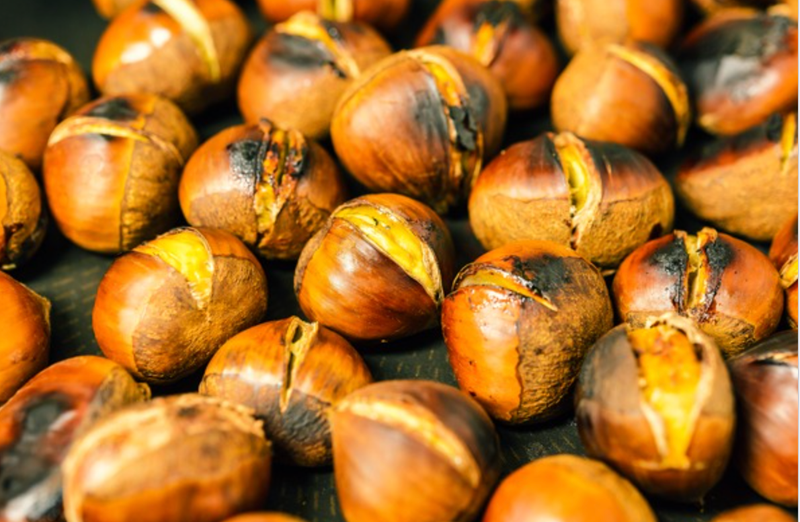
“군(Gung)” means “to roast,” while “밤(Bam)” means “chestnut.”
In other words, they’re roasted chestnuts,
but Korean roasted chestnuts are larger and fluffier than Japanese ones!
Features of Korean Roasted Chestnuts
At Korean roasted chestnut stalls,
chestnuts are roasted while being stirred in a large iron pot.
The savory aroma that rises is simply irresistible✨
Slits are cut into the shells
Since they’re already scored, they’re very easy to peel!
Large, fluffy, and tender
Korean chestnuts are large and satisfyingly filling.
They’re fluffy and tender inside, with a naturally sweet flavor that spreads throughout your mouth.
Full of nutrients
They’re packed with nutrients that are good for both beauty and health,
including dietary fiber, vitamin C, and potassium💕
In Korea during winter,
buying a paper bag full of roasted chestnuts and eating them piping hot as you walk…
This is truly one of the quintessential sights of winter in Korea🌰
🌽 ⑦ 찰옥수수(チャルオクスス)|Prepare to be amazed by chewy corn!

「찰(チャル)」means “glutinous rice,” while 「옥수수(オクスス)」means “corn.”
In other words, it means “chewy corn,” but…
Actually, this is completely different from Japanese corn!
Differences from Japanese Corn
Japanese Sweet Corn
・Yellow and sweet
・Pop-like, crisp texture
・Juicy and succulent
Korean Chal-oksusu
・Whitish or pale yellow
・Chewy, pop-like texture
・Moderately sweet
・High in starch
When trying it for the first time,
“Wait, is this really corn?!”
Most people are surprised 😂
Why the Texture Is So Addictive
The greatest appeal of chal-oksusu
is undoubtedly its uniquely chewy texture.
It pops with every bite,
while still being satisfyingly chewy,
making it deliciously addictive once you try it✨
Lucky If You Find It in Winter
Chal-oksusu is
a delicacy often seen at street stalls and markets in winter.
If you find it, be sure to give it a try💕
It is a winter treat unique to Korea
that is hard to enjoy in Japan.
🥟 ⑧ Jjinppang(チンパン)|Korean-style steamed buns with meat or red bean filling to warm you up

「찐(チン)」means “steamed,” while 「빵(パン)」means “bread.”
In other words, it is steamed bread,
a Korean-style steamed bun similar to nikuman and anman in Japan!
Features of Korean 찐빵
They are similar to the steamed meat buns sold at Japanese convenience stores,
but Korean 찐빵 are characterized by their chewy and fluffy dough.
When you eat them freshly steamed,
they gently warm you from the inside out✨
Classic varieties
・Vegetable buns(야채만두)
・Meat buns(고기만두)
・Red bean buns(팥빵)
・Curry buns(카레빵)
One of the pleasures of 찐빵 is that the fillings and seasonings vary slightly
depending on the food stall or market.
🗺️ Where can you eat them? Popular winter street-food spots in Korea
“Where can I eat all of these street foods?”
We’re here to answer that question!
Myeongdong
Features
・Street food stalls line the streets from evening to night
・Many shops can accommodate Japanese speakers
・Since 2024, more stalls have started accepting card payments
・A tourist-friendly area, but the flavors are authentic
Why we recommend it
Simply walking along Myeongdong’s main street
will lead you to almost every kind of street food.
The street food crawl of “bungeoppang → hotteok → eomuk”
is an incredibly fun way to enjoy the area✨
Namdaemun Market
Features
・The oldest market in Seoul
・Frequently visited by locals as well
・Home to a legendary hotteok stall
・Many street food stalls are open from the daytime
Why we recommend it
“Sinpo Hotteok” at Namdaemun Market
is a famous shop known by every Korean.
There will almost certainly be a line,
but it’s worth the wait🔥
Gwangjang Market (Gwangjang Sijang)
Features
・Famous for its “Food Alley”
・Authentic local favorite
・Plenty of restaurants in addition to street food stalls
・Open until late at night
Recommended Highlights
In addition to street food,
you can enjoy all kinds of Korean cuisine, including savory pancakes and yukhoe.
Recommended for those who want to fully experience the local atmosphere💕
Hongdae (Hongdae)
Features
・Center of youth culture
・Many innovative and trendy street food stalls
・Lively until late at night
・Stylish and casual atmosphere
Recommended Highlights
There is plenty of SNS-worthy “innovative street food,” including cheese hotteok and Oreo hotteok✨
🇯🇵 How Korea Differs from Japan|What Makes Korean Street Food Culture So Interesting!
Korean street food culture has
unique rules and ways of enjoying it that are slightly different from Japan.
The more you learn, the more moments of “I see!” you’ll discover—that’s part of the appeal.
① There are many seasonal street food stalls
In Japan, street food stalls
often appear at specific times, such as festivals and events.
In Korea, on the other hand, the lineup changes with the seasons.
Pungoppang, in particular, is a strictly seasonal treat.
You’ll hardly see it in summer.
This seasonal feeling of “only being able to eat it right now”
makes street food even more special✨
② Self-service culture
At eomuk stalls, you’ll often see a system where
“you take the skewers yourself and report the number at the end.”
This is a style you don’t often see in Japan.
It’s a culture built on trust between the shop and its customers,
and one of the things that gives it a distinctly Korean feel💕
③ Innovative menu items keep appearing
Korean street food is constantly being updated.
Even when it comes to the classic hotteok,
there’s a wide variety, including cheese, Oreo, and vegetable-filled versions.
“Even at a street food stall I’ve visited before, I can try a different flavor this time.”
That sense of fun is another part of the appeal✨
④ The Street Food Culture Is Well Established
In Korea, enjoying street food in winter is a classic date activity.
You often see couples enjoying
street food while holding hands.
It is especially popular among younger generations,
and it is impressive to see how firmly the street food culture has taken root💕
✨ Summary|Korea in Winter Is Worth Visiting for the Street Food!
Korean winters are truly cold, and temperatures often drop below freezing.
But it is precisely because of the cold
that the deliciousness of street food truly stands out✨
Best 8 Korean Winter Street Foods
① Bungeoppang - Crispy fish-shaped pastry
② Hotteok - Melt-in-your-mouth brown sugar and nut filling
③ Gyeranppang - A unique bread with a whole egg inside
④ Eomuk - Korean fish cake with unlimited broth
⑤ Roasted sweet potatoes - Rich sweetness that varies by variety
⑥ Roasted chestnuts - Large, fluffy, and tender
⑦ Chewy corn - A texture completely different from Japan
⑧ Jjinppang - Korea’s version of meat- and red bean-filled steamed buns
Every one of them is a special food that can only truly be enjoyed in Korea during winter.
Another appeal of street food is that it is affordable and easy to enjoy💕
The happiness of biting into piping-hot hotteok
while surrounded by the savory aroma at the Myeongdong street food stalls.
The bliss of sipping warm omuk broth
in freezing temperatures.
This is truly a uniquely Korean way to enjoy winter🔥
“I’m still unsure about traveling to Korea in winter…”
To anyone thinking that, I want to say this loud and clear:
It is absolutely worth going just for the street food!
“I’m a little unsure about traveling to Korea in winter…”
To those of you thinking that, I can say this with certainty.
It is more than worth going even just for the street food.
Make your next trip to Korea a winter trip.
The street food will warm both your body and your heart❄️✨
Bringing you closer to Korea, where trends and exciting discoveries meet, through イェプリコ.
Related Columns
- Perilla Dishes in Seoul: The Definitive Guide to 6 Top Restaurants
- 【Korean Food】A Famous Kimchi Jjigae Restaurant in Gangnam, “Tonggane”
- A Hidden Gem in Anguk: “Jinjaku Kaki” — A New Korean-Japanese Fusion Experience
- Late-Night Gourmet in Gangnam|Complete Guide to【Idepaltchukmi】, a Webfoot Octopus Specialty Restaurant Open Until 6 a.m.
- Korean vegetable bread makes its Osaka debut! Limited time at Hankyu Umeda Main Store.
- Korean Traditional Cuisine Guide|6 Authentic Flavors Tourists Don’t Know About