Oppa Meaning in Korean: What "Kim Oppa" and Eolppa Mean


"Oppa" (오빠) is a Korean term women use to address older men—a biological older brother, a close older male friend, a boyfriend, or even a favorite idol. It literally means "older brother," but unlike the English word, it doesn't require a family relationship at all.
That's why you hear it constantly in K-dramas and K-pop: a woman calling her boyfriend "oppa" isn't calling him her brother—she's signaling closeness and affection. So when someone says "Kim oppa," they're addressing an older man whose family name is Kim in a warm, familiar way.
This guide breaks down what oppa really means, who can say it to whom, when it sounds natural (and when it doesn't), plus related terms you may have run into online, like "eolppa."
Quick answer: Oppa = what a woman calls an older man she's close to. Men use a different word ("hyeong") for older men. Don't use oppa with strangers or in business settings—start with a polite form of address first.
What does oppa (오빠) mean in Korean?

Oppa (오빠) is a term used by women to address older men. The literal translation is "older brother," but the actual usage is much broader than the English equivalent suggests.
In English, "big brother" almost always means a family member. In Korea, even without a blood relationship, once people become close, a woman may call an older man "oppa." Knowing this difference makes conversations in K-dramas and K-pop lyrics much easier to follow—it's a word about relationship and closeness, not just family.
Who can you call oppa? Real situations
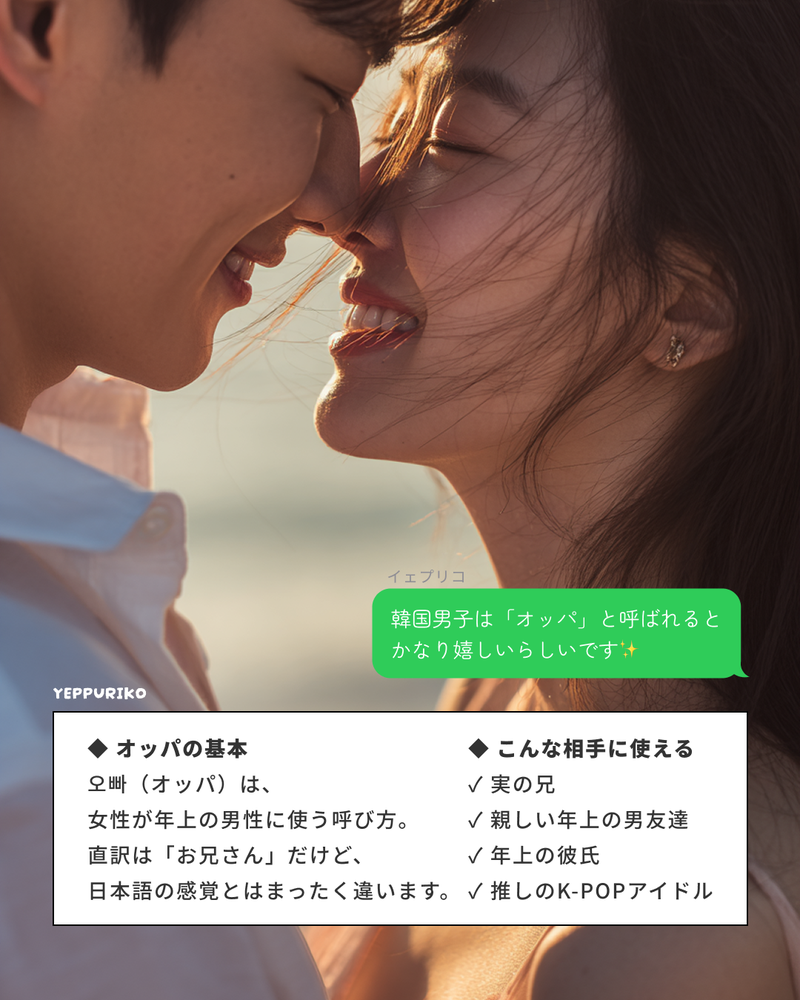
So who actually gets called oppa? Here are the typical situations. 💜
Biological older brother. This is the basic usage within a family.
Close older male friend. In Korea, "oppa" may be used for an older man when you have a close relationship. However, it is best to avoid using it suddenly when meeting someone for the first time.
Older boyfriend. Calling your boyfriend "oppa" is one of the common ways of addressing a romantic partner in Korea. This is the usage you'll notice most in K-dramas.
Your favorite K-pop idol. Among fans, there are also cases where older idols are called "oppa" (depending on the atmosphere and context).
What does "Kim oppa" mean?
You'll often see "family name + oppa" — for example, "Kim oppa" (김 오빠). It simply means a woman is addressing an older man surnamed Kim with the familiar term oppa. It works the same with a first name ("Minho oppa"). Either way, it signals the speaker is a woman, the man is older, and the two are on friendly, close terms.
Oppa vs. hyeong: it depends on who's speaking
One point that surprises many learners: oppa is a form of address used by women. When a man addresses an older man, he uses "형 (hyeong)" instead.
| Speaker | Addressing an older man |
|---|---|
| Woman | 오빠 (oppa) |
| Man | 형 (hyeong) |
If you've seen the slang term "eolppa" (얼빠) while browsing K-pop content, note that it's a different word despite the similar sound—it's fan slang, not a form of address. It combines 얼굴 (eolgul, "face") with a slang suffix and refers to a fan who's drawn to someone mainly because of their looks. Don't mix it up with oppa.
When not to use oppa: etiquette that keeps it natural

Oppa is a convenient word, but depending on the situation, it can feel out of place. Keep these points in mind before you try it in Korea. ⚠️
Start polite when meeting someone for the first time. At first, it is safest to use "〇〇씨 (〇〇-ssi)" or "〇〇님 (〇〇-nim)." Once you become closer, choose how to address them based on their reaction.
Avoid it in business settings. In professional settings, it is common to use honorifics such as "선배님 (seonbaenim)."
Check whether they're actually older. If you're not sure whether the other person is older than you, it's safest to confirm before using it—oppa only applies to men older than the speaker.
Editor's note: When in doubt, name + 씨 (ssi) is always a safe default. Let the other person invite you to switch to oppa—that shift is itself a sign the relationship has gotten closer.
Phrases with oppa you can actually use
Here are some examples of phrases commonly used in conversation.
- 오빠, 밥 먹었어? (Oppa, bap meogeosseo?) → Oppa, did you eat? (A casual greeting used between people who are close)
- 오빠, 고마워〜 (Oppa, gomawo〜) → Oppa, thank you〜
- 오빠, 보고 싶어 (Oppa, bogo sipeo) → Oppa, I miss you (For someone you're close to or a romantic partner)
Key takeaways
Oppa (오빠) is a term of address used by women for older men, and in Korea it also works as an expression that conveys closeness in the relationship—no blood relation required. Men use hyeong (형) instead, and "Kim oppa" just means an older man named Kim addressed warmly.
Be mindful of the situation (first meeting, work, private) and your distance from the other person, and you'll use it naturally. Next step: try listening for oppa vs. hyeong in your next K-drama episode—you'll instantly read the relationships better. 🇰🇷
FAQ
What does "Kim oppa" mean?
It means a woman is addressing an older man whose family name is Kim in a familiar, affectionate way. "Family name (or first name) + oppa" is a common pattern in Korea and in K-drama dialogue. It signals closeness, not a family relationship.
What does "eolppa" mean, and is it related to oppa?
No—despite the similar sound, eolppa (얼빠) is unrelated fan slang. It comes from 얼굴 (eolgul, "face") and describes a fan who likes someone primarily for their looks. Oppa (오빠) is a form of address for older men; eolppa is a label for a type of fan.
Can I call someone oppa the first time we meet?
It's best not to. Start with a polite form like "〇〇씨 (ssi)" or "〇〇님 (nim)," and switch only after you've built a closer relationship and gauged the other person's reaction. In business settings, honorifics such as "선배님 (seonbaenim)" are the norm instead.
Related Columns
- 4 medications for fever at midnight available at Korean convenience stores
- 6 Negative Expressions in Korean|Real Emotional Phrases Learned from Dramas
- How to Choose a K-Drama So You’ll Never Again Wonder, “What Should I Watch Next?”
- 밥먹었어 Meaning: Why “Did You Eat?” Is a Korean Greeting
- The Korean remake film “Tonight, from the World” is trending on Netflix.
- A Complete Guide to Using “좋아요 (Joayo),” a Phrase You Always Hear in Korean Dramas