What Does Arirang Mean? Explaining How It Became a Symbol of Korean Culture
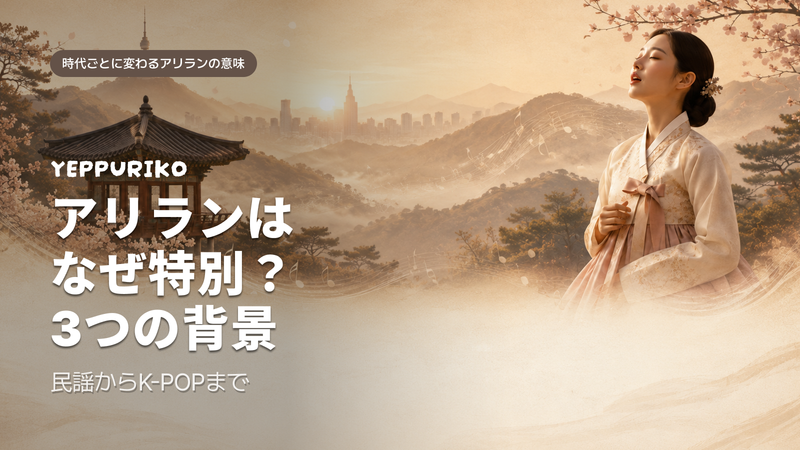
What Does Arirang Mean?
Explaining the Background Behind Its Becoming a Symbol of Korean Culture
🎵 Why a single folk song has continued to be chosen for over 100 years

This is イェプリコ, a one-stop guide to Korea where you can enjoy Korean beauty, travel, food, and more with peace of mind.
📖 Table of Contents
① What kind of folk song is Arirang?
② Why did it become a symbol of resistance and solidarity?
③ How far has modern Arirang spread?
④ What can we learn from the meaning of Arirang?
⑤ Summary
🎵 What kind of folk song is Arirang?

In fact, it is very difficult to explain the meaning of Arirang in a single phrase.
It is not merely an old folk song, but a phrase through which the people of the Korean Peninsula have continued to sing of “separation” and “longing for home,” carrying entirely different meanings depending on the era.
serves as a cultural keyword
that points to Korea itself.
Arirang is a general term for folk songs with diverse variations found throughout the Korean Peninsula.
Different songs have been passed down in each region, including Gangwon-do Arirang, so it does not refer to just one song.
The themes shared by the lyrics are separation, setting out on a journey, and longing for one's hometown.
The sorrow of the common people is interwoven with hope for overcoming it, positioning Arirang as a representative expression of “han” — an emotion in which resignation and longing coexist — often discussed in Korean culture.

✅ About the Etymology
There is still no established theory regarding the etymology of the word “Arirang” itself. Several theories exist, including “the name of a beautiful maiden” and “the name of a mountain pass,” and in literature and criticism, “crossing Arirang Pass” has long been used as a metaphor for hardship.
🕊️ Why Did It Become a Symbol of Resistance and Solidarity?

Arirang’s background, which goes beyond being merely a song, lies in the history since the colonial period.
A simple folk song about parting and longing for one’s homeland eventually came to be sung as a symbol of resistance and solidarity.
People who were forced to leave their hometowns, and people who longed for their lost land. Arirang was the “common vessel” through which everyone could share those emotions.
Precisely because it was not one person’s song but everyone’s song, it was able to spread across political boundaries.
It has been passed down in both the North and South and continues to serve as a song expressing ethnic identity.
The phenomenon of one song continuing to be sung on both sides of a politically divided region can be considered a rare example worldwide.
✅ Registration with UNESCO
In 2012, Arirang was inscribed on the UNESCO Intangible Cultural Heritage List (Source: UNESCO official website). This can be said to be the result of its symbolism receiving international recognition.
🎤 How far has modern Arirang spread?

Arirang is not confined within the framework of traditional performing arts.
Arrangements for wind ensembles and choirs are performed around the world, and the name is also widely used for movie and documentary titles and event names.
In recent years, it has also been incorporated as a motif in K-POP, coming to function as a keyword that connects tradition and contemporary culture.
The strength of Arirang lies in the fact that something old continues to be chosen not as an object of nostalgia, but as material for new forms of expression.
As a further derivative use, the three syllables of “Arirang” are also used in store and product names.
The name Arirang itself has come to carry such cultural meaning that it can convey the sentiments of “Korean-ness” and “an authentic atmosphere” in a single word.
💡 What can we learn from the meaning of Arirang?

The history of Arirang teaches us how cultural symbols are formed.
Even when its etymology is unclear, a word becomes a symbol when people’s emotions accumulate around it.
A folk song that sings of sorrow becomes a song of resistance, the song of resistance becomes a national song, and the national song transforms into a global motif.
The path Arirang has traveled is itself the process by which culture continues to live on while updating its meaning with each era.
So when you encounter the word “Arirang” while exploring Korean culture, consider that behind it lie more than 100 years of layers of emotion.
That depth is why this word continues to be chosen even today.
✨ Summary
☑ Arirang is not a single song, but a collective term for folk songs passed down throughout the Korean Peninsula
☑ A vessel for the shared emotions of the people, expressing “separation,” “longing for one’s homeland,” and “han”
☑ Since the colonial period, it has come to be sung as a symbol of resistance and solidarity
☑ A national song that transcends political boundaries and continues to be sung on both sides of the North-South divide
☑ Registered as an Intangible Cultural Heritage by UNESCO in 2012 (Source: UNESCO official website)
☑ Today, it is used as a motif in all kinds of settings, including K-POP, films, and store names
☑ When you encounter the word Arirang, remember that it carries more than 100 years of emotional layers in its background
We brought you reliable Korean information that makes Korea feel closer and more reassuring, from イェプリコ.
Discover trends and exciting encounters that connect you with Korea on イェプリコ.
🌐 Web:https://yeppuriko.com/
Related Columns
- Korea Starbucks LEAF TO COFFEE: 6 items, 2 mugs not in stores
- Busan PASS: The Difference Between BIG3 and BIG5
- 8 HYBE sacred spots and how to get around Seoul
- 10 Must-Buy Items at Korean Convenience Stores, Starting from 900 Won
- When it comes to taking Korean ramyeon home, the deciding factor is the toppings
- The 3 Korean transit cards — which one is actually the right choice?