What do “미쳤어?・왜 그래?” mean? K-Drama Emotional Expression Phrases Lesson

🎬 Correctly understand phrases frequently heard in K-dramas
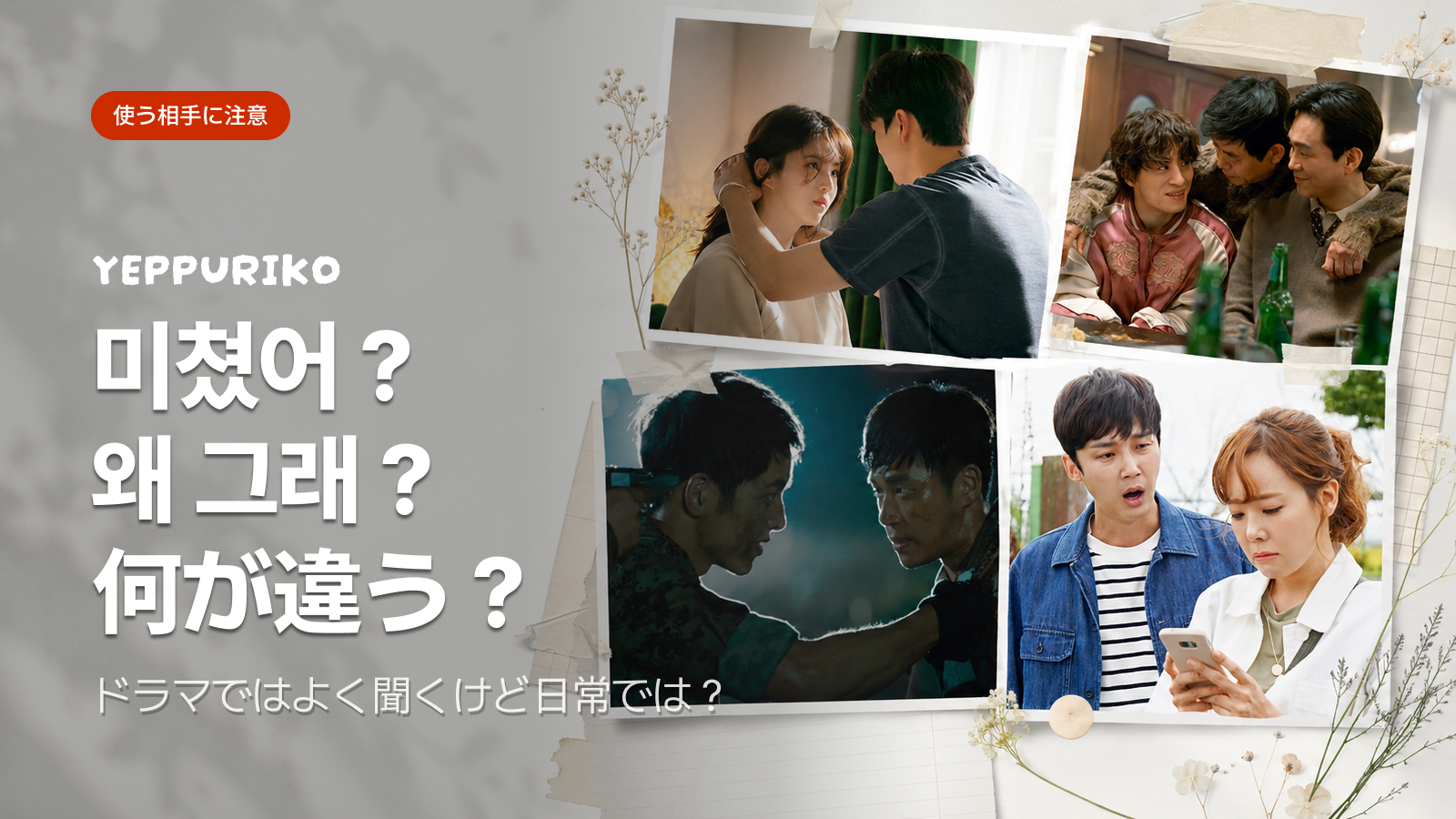

Yeppuriko is your one-stop guide to Korea, where you can enjoy Korean beauty, travel, food, and more with peace of mind.
🎯 K-drama tense scenes become much easier to understand once you know these two things
Want to enjoy K-dramas without subtitles and understand a little more of the Korean dialogue? When you feel that way, the first phrases you should learn are surprisingly simple.
「미쳤어?」(Michyeosseo) and 「왜 그래?」(Wae geurae), which repeatedly appear in intense confrontation and confession scenes, are two representative examples.
「왜 그래?」 can express either concern or anger, depending on the tone.
Simply understanding these two phrases will bring you much closer to the emotional flow of dramas.
💬 Phrase 1 「미쳤어?」 (Michyeosseo)

Literally, it means “Are you crazy?”, but in everyday use, it has a nuance closer to “Are you out of your mind?” or “What are you doing?”
It is a versatile phrase that can convey surprise, exasperation, or concern, and it appears repeatedly in dramas, especially in emotionally charged scenes.
✅ Situations in which 「미쳤어?」 is used
・ When you are surprised by someone's unexpected actions
・ When the other person is about to do something dangerous
・ When you hear an unbelievable confession or statement
⚠️ Be careful who you use it with
「미쳤어?」 is a strong expression, so it should not be used with someone older or in a position of authority, or with someone you are meeting for the first time. It is a casual phrase used among close friends, romantic partners, or people of the same age. Using it with someone older may come across as rude.
💬 Phrase 2「왜 그래?」(Wae geurae)|The meaning changes depending on the tone

The literal translation is “What’s wrong?” However, depending on how it is said, 「왜 그래?」 can express either concern or anger—that is what makes it interesting.
✅ Gently and in a low voice → Concerned mode
When you say it slowly in a lower tone of voice, it conveys the feeling, “Are you okay? Are you pushing yourself too hard? I’m here with you.” This is the kind of phrase a protagonist uses when showing concern for someone in a heart-fluttering scene.
⚡ Strong and fast → Anger and confusion mode
When pronounced strongly and quickly, it conveys anger or confusion, like “Why does it turn out that way?! I can’t believe this.” This is the pattern that appears when someone aggressively confronts another person in an intense scene.
Even with the same three letters, completely opposite emotions can be expressed just through intonation and speed. This is one of the things that makes Korean conversation so rich.
🎬 With just these two, you can understand dramas even better

Let’s look at how they are used, using a scene from a drama as an example.
✅ A common confession → confusion scene
A:「나 사실… 너 좋아해. 우리 만나자」
(Actually… I like you. Let’s date.)
B:「갑자기 왜 그래? 너 미쳤어? 우리 친구잖아!」
(What’s gotten into you all of a sudden? Are you crazy? We’re friends!)
A:「장난 아니야. 나 진심이라고」
(I'm not joking. I mean it.)
B's 「왜 그래?」 has a strong tone (confused mode), while 「미쳤어?」 expresses bewilderment mixed with surprise. Even without following the subtitles, knowing this pattern makes the flow of emotions come across naturally.
✨ Summary
□ 「미쳤어?」=Are you out of your mind? A versatile phrase that can convey surprise, bewilderment, or concern
□ A casual expression used among close acquaintances, not with superiors or people you're meeting for the first time
□ 「왜 그래?」=What's wrong? Depending on the tone, it can express either concern or anger
□ Gentle and low=concerned mode, strong and fast=anger and confusion mode
□ When these two appear together in a confession or intense confrontation scene, you'll be able to understand the direction of the emotions
The moment a drama begins to make sense without relying on subtitles comes from accumulating these small realizations. The next time you watch a Korean drama, try listening for these two phrases first.
We brought you reliable Korean information that brings Korea closer to you, from イェプリコ.
At イェプリコ, discover trends and exciting encounters that connect you with Korea.
Related Columns
- Korea Starbucks LEAF TO COFFEE: 6 items, 2 mugs not in stores
- Busan PASS: The Difference Between BIG3 and BIG5
- 8 HYBE sacred spots and how to get around Seoul
- 10 Must-Buy Items at Korean Convenience Stores, Starting from 900 Won
- When it comes to taking Korean ramyeon home, the deciding factor is the toppings
- The 3 Korean transit cards — which one is actually the right choice?