“Subcision”: A treatment that tackles deep acne scars from the side.

💉 An approach from the side that reaches the adhesions

This is Yeppuriko, your one-stop guide to enjoying Korean beauty, travel, and food with peace of mind.
📋 Table of Contents
1. What Is Subcision? A Simple Explanation of How It Works
2. Suitability by Type of Acne Scar
3. Differences from Lasers and Dermapen
4. Treatments That Can Be Expected to Have a Synergistic Effect When Combined
5. Recommended Number and Intervals of Treatments
6. Downtime and Impact on Daily Life
7. Points to Note and What to Confirm During a Consultation
8. Summary
💡 What Is Subcision? A Simple Explanation of How It Works
Have you ever tried lasers or Dermapen but found that deep acne scars hardly changed?
For such deep indentations, one treatment option is 『subcision』.
by cutting the “adhesions” beneath the skin.
※Results and recovery may vary from person to person
Specifically, a special medical needle is inserted beneath the skin to cut and release the fibrous tissue (adhesions) that is pulling the indentation downward.
Once the adhesions are released, the skin that had been pulled down is freed.
Then, during the wound-healing process, collagen production is promoted, and the indented area is expected to gradually rise.
However, it may take time for changes to appear, and the number of treatments required varies from person to person.
🔍 Suitability by crater type
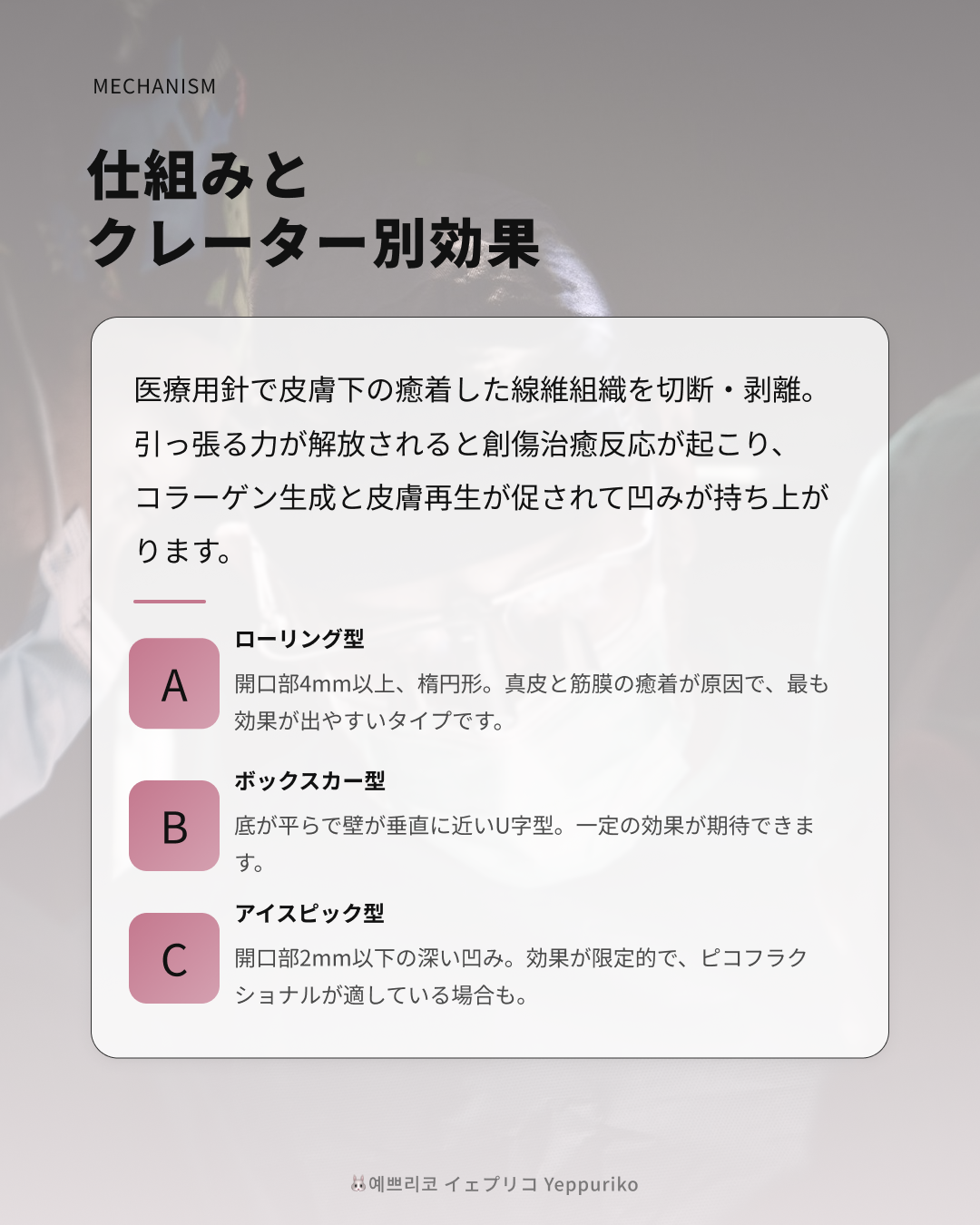
There are three main types of acne-scar craters.
Subcision is considered to be particularly effective for one of these types.
✅ Rolling type (considered the type most likely to show results)
Characterized by a relatively large opening (generally 4 mm or more) and a gently oval-shaped depression. The boundaries are blurred, and this type is often caused by adhesion between the dermis and fascia. It is considered to be well suited to the approach used in subcision.
✅ Boxcar type (some improvement may be expected)
A U-shaped depression with a flat base and relatively vertical walls. Although it is not as well suited as the rolling type, it may be treatable depending on the doctor’s assessment.
⚠️ Ice pick type (often considered to have limited effectiveness)
A deep depression with an opening of 2 mm or less, as if pierced by a needle. Due to its structure, the subcision approach may have difficulty reaching it, and other treatments such as Pico fractional laser may be more suitable.
It can sometimes be difficult to determine the type of your acne scars with the naked eye alone.
It is important to have them thoroughly assessed by a doctor.
⚡ Differences from Laser Treatments and Derma Pen

Derma Pen and fractional laser treatments primarily act in the vertical direction (perpendicular to the skin’s surface).
Because it works by damaging the dermis to stimulate collagen production, it is effective for superficial depressions, but it may have difficulty reaching adhesions attached horizontally beneath the skin.
On the other hand, kaketeke subcision is an approach that cuts fibrous tissue while moving a needle horizontally.
Therefore, it is considered to be particularly suited to directly targeting the adhesions causing the depressions.
Neither treatment is inherently superior; the appropriate treatment differs depending on the cause and type of the acne scars.
💉 Treatments That May Provide Synergistic Effects When Combined

Subcision alone may produce visible changes, but combining it with other treatments may also help achieve more natural-looking improvement in some cases.
✅ Hyaluronic Acid Injections
Hyaluronic acid may be injected into the space created by the cutting procedure to help prevent re-adhesion. It is said to create an environment conducive to the formation of new tissue during the six months to one year before it is absorbed, and may be selected particularly for deep depressions.
✅ Polynucleotide (PN) Injections (such as Rejuran S and Juvelook)
This is an injectable treatment that enhances the skin’s regenerative ability and supports collagen production. When combined with subcision, it may help achieve a more natural-looking result. The doctor will determine which treatment to combine it with based on the condition of your skin.
📅 Recommended Number and Interval of Treatments
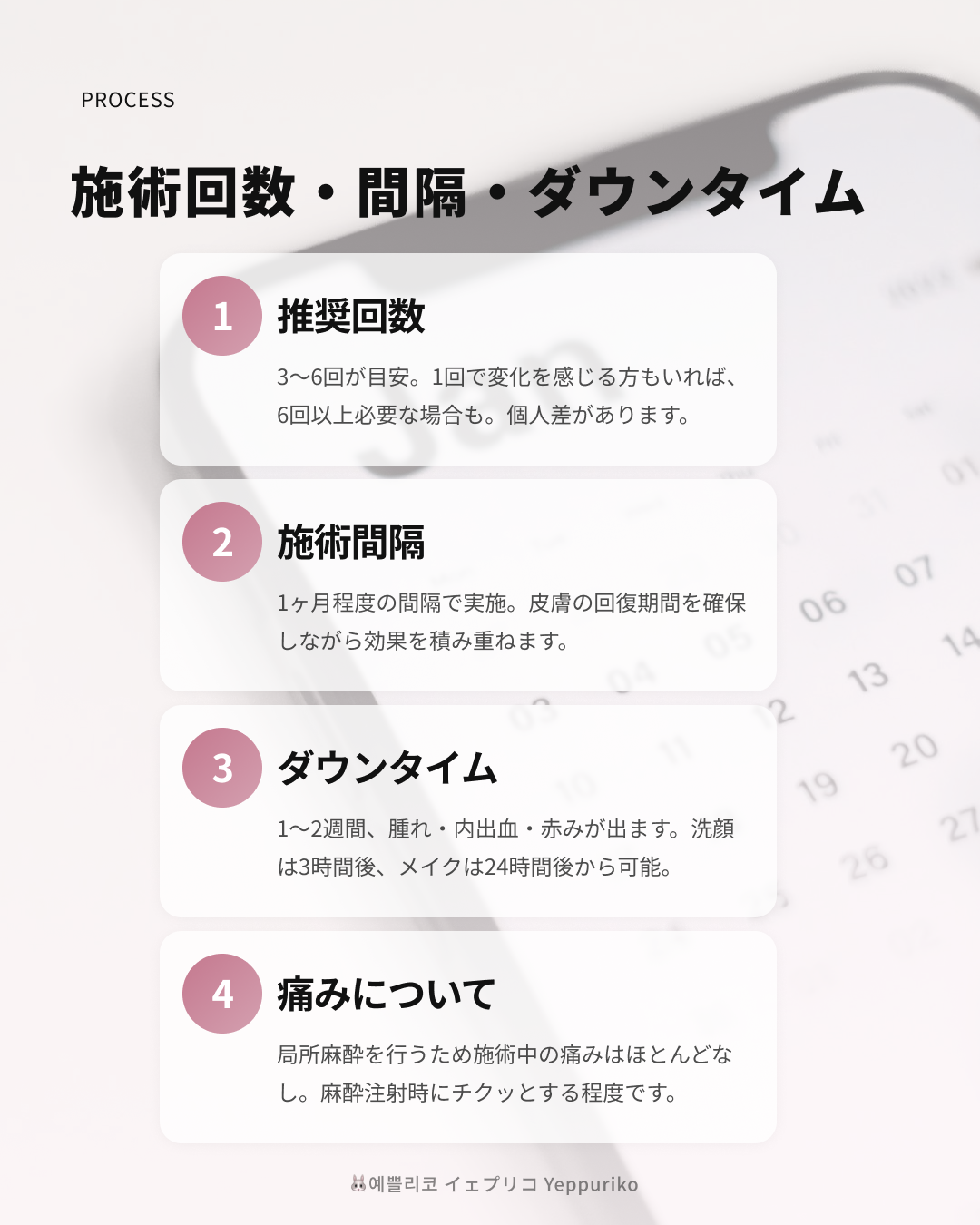
Generally, 3–6 treatments at intervals of approximately one month are recommended.
However, some people notice changes after just one treatment, while others may require more than six treatments.
The number of treatments needed varies greatly depending on the depth and extent of the acne scars and the skin’s ability to recover.
The necessary number of treatments will be confirmed with the doctor each time while monitoring your progress.
🩹 Downtime and Impact on Daily Life
Since subcision involves inserting a needle under the skin, there is a certain amount of downtime.
✅ Estimated Downtime
Swelling, bruising, and redness may persist for about 1–2 weeks.
The duration may vary depending on the individual and the treatment area.
✅ Restrictions on daily activities (general guideline)
Face washing: Often possible 3 hours after the procedure
Makeup: Often possible 24 hours after the procedure
Bathing: Shower only on the day of the procedure
※Always prioritize the clinic’s instructions
As local anesthesia is used, pain during the procedure is often reduced.
Many people report feeling only mild pain during the anesthesia injection, but individual sensitivity varies.
🗒️ What to confirm during your consultation
✅ Things to ask during your consultation

・Whether my acne scars are suitable for subcision
・Whether another treatment is needed first if active acne (inflammation) is present
・Which combination of treatments is suitable for my condition
・The expected number of sessions and intervals
・Things to be careful about during the downtime
Subcision is not effective for all types of acne scars.
A doctor’s examination is necessary to determine whether it is suitable for you.
If you have acne with particularly persistent inflammation, treatment for the inflammation may be prioritized first.
We recommend consulting a specialist first in order to create a treatment plan suited to your skin condition.
✨ Summary
Here is a summary of what to check before considering subcision.
☑ Have a doctor examine your type of acne scars (especially whether they are rolling scars)
☑ Confirm that you do not have any active acne before consulting a doctor
☑ Make a plan on the assumption that multiple treatments may be necessary
☑ Incorporate the downtime (swelling and bruising for 1–2 weeks) into your schedule
☑ Discuss combination treatment options (such as hyaluronic acid and PN injections) with your doctor
☑ Begin treatment with the understanding that results vary from person to person
For deep acne scars that lasers and Dermapen could not reach, subcision is one treatment option that approaches the underlying structure from within.
However, determining whether it is appropriate is important, so please start by consulting a specialist.
Related Columns
- Korean Acne Treatment 2026|Why the Approach Shifted from “Removal” to “Regeneration”
- Korea Starbucks LEAF TO COFFEE: 6 items, 2 mugs not in stores
- Busan PASS: The Difference Between BIG3 and BIG5
- 8 HYBE sacred spots and how to get around Seoul
- 10 Must-Buy Items at Korean Convenience Stores, Starting from 900 Won
- When it comes to taking Korean ramyeon home, the deciding factor is the toppings