Which of Seoul’s four transportation cards is ultimately the right one?
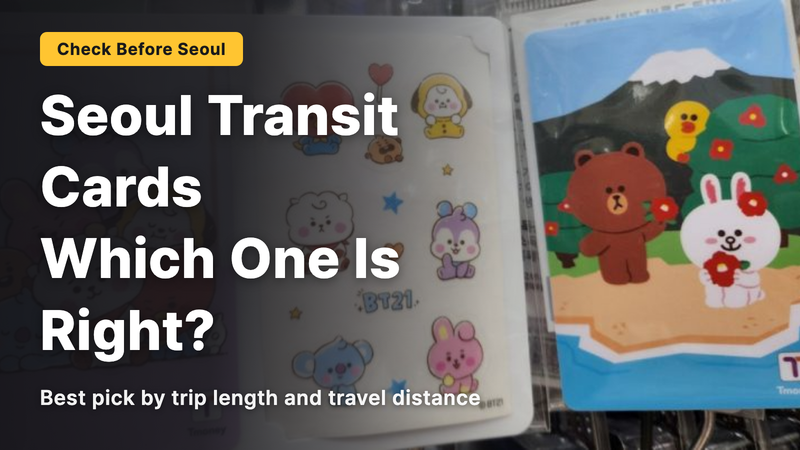
To put it simply, if you’re just getting around Seoul normally for 3–4 days, T-money(티머니)is more than enough. You can buy one for 3,000–5,000 won, and it has no expiration date, so you can use it again on your next trip to Korea. There’s no need to waste time agonizing over this.
The deciding factors are just three: “How many days are you staying?”, “Are you only traveling around Seoul?”, and “How many times will you go back and forth to the airport?” The basic subway fare is 1,500 won in cash, or 1,400 won with a transportation card. Even a 100-won difference per ride adds up if you take public transportation 6–7 times a day.
There’s one more thing: the rules around ticket machines changed on March 17, 2026. Taking that into account, let’s go through the four types in order.
3-Question Chart/① Staying 3–4 days・Normal amount of travel → T-money ② Taking public transportation all day・Longer stay → Climate Companion Card(기후동행카드) ③ Going back and forth between the airport and the city multiple times → M-Pass ④ Want to exchange money at the same time → WOWPASS
1️⃣ T-money(티머니)— The standard choice if you’re unsure
A prepaid transportation card that can be used on subways, buses, and taxis in Korea. It can also be used to pay at convenience stores and some other shops, so one major benefit is that you don’t have to carry around small change.
You can buy one at subway stations and convenience stores (GS25, CU, 7-Eleven). It costs around 3,000–5,000 won, and you can top it up at a station charging machine or at the counter of a convenience store. Station charging machines support Japanese-language displays, so you won’t get stuck even on your first day.
It has three main advantages. You can ride more cheaply than with cash (the basic fare is reduced from 1,500 won to 1,400 won), you may not be charged an additional fare when transferring between the subway and buses, and it has no expiration date. Even if you return home without using up the remaining balance, you can use it again on your next trip to Korea. There are also plenty of character and tourist attraction designs, so many people buy one as a souvenir🔖

2️⃣ Climate Companion Card(기후동행카드)— For people who can get their money’s worth from unlimited rides
A card that lets you take unlimited rides on subways and city buses within Seoul for a flat fee. It also covers maeul buses (local neighborhood buses) and late-night buses, and is convenient for people who want to use the Ttareungyi(따릉이)bike-sharing service.
Prices range from 5,000 won for a 1-day pass to 20,000 won for a 7-day pass, while long-term passes cost 62,000 won for 30 days, or 65,000 won for a 30-day pass with Ttareungyi. Discounts are also available for people aged 19–39. You can buy one at the customer safety offices in subway stations, Gimpo Airport, tourist information centers, and convenience stores (including GS25 and CU). You can top it up at station ticket machines, which support Japanese and accept both cash and credit cards.
Pay attention to the coverage area. The Shinbundang Line, intercity buses, and airport buses are excluded, and the card cannot be used at Incheon Airport. You may also be charged an additional fare if you get off outside Seoul. It’s better not to count on it as a way to get from the airport.

3️⃣ WOWPASS — Combine currency exchange and transportation in one card
Issued for 5,000 won, this card includes T-money functionality. It is an option for people who want to handle currency exchange with a single card. If you want to take care of the hassle of exchanging cash and purchasing a transit card all at once, this is the quickest option.

4️⃣ M-Pass — For itineraries with frequent airport round trips
With prices ranging from 15,000 won for a 1-day pass to 64,500 won for a 7-day pass, this pass can be used up to 20 times per day. It is suited to itineraries that involve extensive travel between the airport and the city, or for people who take public transportation many times in a day. Conversely, on a sightseeing-focused trip spent walking around areas such as Myeongdong and Seongsu, you may not use all the available rides.
Lining up the 4 types makes the choice clear
| Card | Price | Best for |
|---|---|---|
| T-money | 3,000–5,000 won for the card+top-up | Short trips・a typical amount of travel. No expiration date, making it suitable for repeat visitors |
| Climate Card | 5,000 won for a 1-day pass~20,000 won for a 7-day pass/62,000 won for a 30-day pass | People who use public transportation frequently within Seoul・long-term stays |
| WOWPASS | 5,000 won issuance fee | People who also want to take care of currency exchange at the same time (with T-money functionality) |
| M-Pass | 15,000 won for a 1-day pass~64,500 won for a 7-day pass | Up to 20 rides per day. Itineraries with frequent airport round trips |
JCB cards can be used at ticket vending machines from March 17, 2026
This is the biggest change this year. From March 17, 2026, JCB cards issued outside South Korea, including Japan can be used at Seoul Metro ticket vending machines. This applies to the purchase of single-journey tickets and the purchase and top-up of Climate Cards.
Things that previously required cash can now be completed by card. Since you can pass through the ticket gates without having to prepare cash immediately after arrival, this is a subtle but useful change for late-night arrivals or tight connections✨ (Source: るるぶ&more. “【韓国現地レポ】最新版!韓国・ソウルの交通カード徹底攻略”)
Summary
For a 3–4-day trip, choose T-money; for riding all day or a long stay, choose the Climate Card; if you’ll be traveling back and forth to the airport repeatedly, choose M-Pass; and if you also want a currency exchange function, choose WOWPASS. That’s all there is to it—just these four options.
There’s only one thing to do before traveling to Korea: roughly count how many times you’ll ride public transportation each day on your itinerary. If you have several days when you’ll ride more than 6–7 times a day, an unlimited-pass option is best; otherwise, T-money is more than sufficient. If you have a JCB card, there’s no problem even if you plan to purchase it at a ticket machine locally.
Frequently Asked Questions
Can I ride the Seoul subway without buying a transportation card?
Yes. You can simply purchase a single-ride ticket from a ticket machine. However, the basic fare is 1,500 won in cash compared with 1,400 won with a transportation card, so a card is more economical if you’ll be riding multiple times. Starting March 17, 2026, you can also purchase a single-ride ticket from a ticket machine using a JCB card issued in Japan.
Can I use the Climate Card at Incheon Airport?
No. It is valid on Seoul’s subway lines and city buses (including village buses and late-night buses), but not on the Shinbundang Line, intercity buses, or airport buses. You can purchase it at Gimpo Airport, but it is safest to budget separately for airport transportation costs. An additional fare may also be charged if you get off outside the city.
Can I use my remaining T-money balance on my next trip to Korea?
Yes. T-money cards do not expire, so you can return home with the remaining balance on the card and use it as is on your next trip. You can add credit at subway-station top-up machines and at convenience-store counters (including GS25, CU, and 7-Eleven). Station top-up machines support Japanese-language displays.
Related Columns
- Korea Starbucks LEAF TO COFFEE: 6 items, 2 mugs not in stores
- Busan PASS: The Difference Between BIG3 and BIG5
- 8 HYBE sacred spots and how to get around Seoul
- When it comes to taking Korean ramyeon home, the deciding factor is the toppings
- The 3 Korean transit cards — which one is actually the right choice?
- Seoul FW: The Right Way to Enjoy 7 Days for Free