Daiso Diet Supplement in Korea: Which of 3 Is Worth Buying?
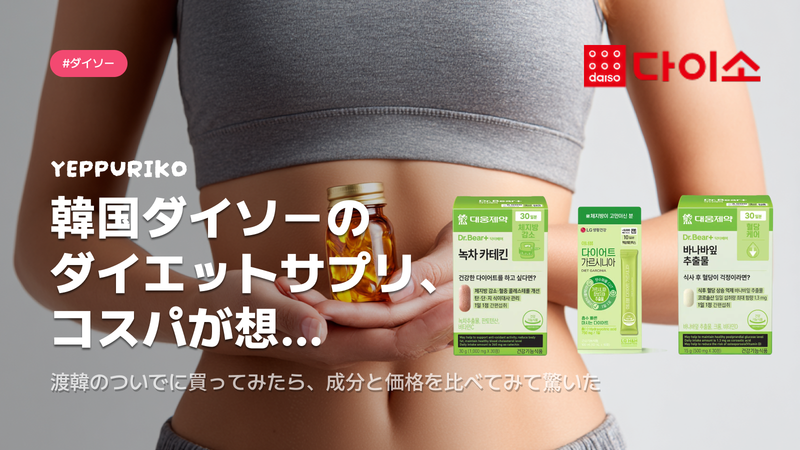
The Daiso diet supplement line in Korea is much cheaper per unit than the brands it was compared with: about 3 to 6 times cheaper for green tea catechins and about 3.5 times cheaper for garcinia, at roughly 5,000 won (about 550 yen) for a month's supply. But a low price is only the starting point. The catechin product contains 360 mg, above the 300 mg daily upper limit indicated by Korea's Ministry of Food and Drug Safety (식품의약품안전처, MFDS), and the three ingredients should not be taken together.
This guide compares the three ingredients (green tea catechins, garcinia cambogia, and banaba leaf) by price, then covers intake precautions and the no-stacking rule. It was compiled by the YEPPURIKO editorial team from the views of Korean nutrition experts and publicly available MFDS standards.
Quick answer: pick one ingredient, not three. Catechins are the cheapest per 100 mg but high in dose, garcinia shows the widest price gap, and banaba leaf is the cheapest per 1 mg but experts point to its low chromium content.

Why is the Daiso diet supplement line in Korea trending now?

Following Olive Young (올리브영), Daiso (다이소) in Korea now sells health foods too. Many travelers are thinking about buying in bulk during a trip to Korea, so YEPPURIKO has organized information on Daiso diet supplements at the ingredient level, based on local information.
For about 5,000 won (roughly 550 yen) and with no prescription required, you can now buy a month's supply of a diet-support supplement. The catch is that as the barrier to purchase has dropped, more people are simply buying them "just to try."
Green tea catechins, garcinia cambogia, and banaba leaf extract are known as ingredients that support dieting. All three are sold at Daiso in Korea, but they have different characteristics, and some combinations should not be taken together.
On price, Daiso's "Dr. Bear" diet line is 3 to 6 times cheaper than other companies per 100 mg. Caution is needed, however, around high doses, ingredient combinations, and the timing of intake.
Daiso diet supplement #1: green tea catechins cost about 5 yen per 100 mg, but the dose is high

On price alone, Daiso's catechin product is very competitive. Dr. Bear green tea catechins cost approximately 46.2 won (about 5 yen) per 100 mg.
Compared with Feelgram Real Catechin (140 won per 100 mg) and Esther Formula Dr. Esther Catechin (272.2 won), that works out to roughly 3 times and 6 times cheaper, respectively. The comparison uses the regular price for a 30-day supply on each official website as of July 2025.
| Product | Price per 100 mg of catechins |
|---|---|
| Daiso (Dr. Bear) | Approx. 46.2 won (about 5 yen) |
| Feelgram Real Catechin | Approx. 140 won |
| Esther Formula Dr. Esther Catechin | Approx. 272 won |
What do catechins do?
Catechins are a representative antioxidant. They are said to promote the utilization of body fat and may help support basal metabolism and improve blood cholesterol levels. Daiso's product also contains vitamin C, so antioxidant benefits can be expected as well.
Why is the 360 mg content a concern?
The catechin content of the Daiso product is 360 mg, exceeding the daily upper limit of 300 mg indicated by Korea's MFDS. Taking 300 mg or more of catechins per day may cause gastrointestinal problems, and in people with concerns about liver function, strain on the liver has been reported (individual differences apply).
So the price advantage comes with a reminder: check the amount per serving on the label instead of assuming that a bigger dose for less money is a better deal.
How should you take Daiso catechins?
Taking them on an empty stomach may burden the gastrointestinal tract, so take them after a meal. They may also interfere with sleep, so it is safest to avoid taking them in the evening or before bed.
Garcinia vs. banaba leaf: which Daiso diet supplement is better value?
Garcinia: outstanding cost-effectiveness

HCA found in garcinia cambogia is said to inhibit the conversion of carbohydrates into fat and to be involved in appetite control. Put simply, it is an ingredient that helps you "avoid storing and avoid overeating."
Garcinia shows a particularly large price difference between products. The Daiso product provides 750 mg per day for approximately 5,000 won (about 550 yen), which is approximately 222.2 won per 1,000 mg. On the same basis, other companies' products cost approximately 793.3 won, a difference of about 3.5 times.
It suits people who find appetite control a challenge, or who want to put cost-effectiveness first as an entry point for diet support.
Banaba leaf: cheapest per mg, but check the chromium

Banaba leaf extract contains 1.3 mg of corosolic acid and is said to help suppress sharp increases in post-meal blood sugar and support weight management. Its role is to help moderate the sharp rise and fall in blood sugar after meals.
| Product | Price per 1 mg of banaba leaf |
|---|---|
| Daiso | Approx. 76.9 won |
| Esther | Approx. 228 won |
| Feelgram | Approx. 400 won |
The roughly 3,000-won Daiso product costs about 76.9 won per 1 mg, and on the numbers alone Daiso is the clear winner here too. This is where experts' opinions differ, though.
Banaba leaf products are generally formulated with chromium as well. Chromium is a mineral with a low absorption rate, so an adequate amount is important. Korean nutrition experts point out that the chromium content of the Daiso product is insufficient, while Feelgram's product is said to stand out by providing a high amount. In other words, there is a reason for the higher price.
Important precaution: people taking blood sugar-lowering medication (diabetes medication) must consult a doctor or pharmacist before taking banaba leaf.
Can you take all three Daiso diet supplements together? No, pick one

This is the most common misconception. Because each one is inexpensive, it is tempting to buy all three and take them together, expecting a bigger effect. You should not do this.
Green tea catechins, garcinia, and banaba leaf are all classified as "functional ingredients that support body fat reduction." Under the Korean MFDS notification standards, taking the same functional ingredients simultaneously is not permitted. Because their functions overlap, you need to choose one.
| Your situation | Ingredient to consider |
|---|---|
| Difficulty controlling appetite | Garcinia |
| Antioxidant and metabolism support | Catechins |
| Also concerned about post-meal blood sugar | Banaba leaf |
Key takeaways
Korean Daiso diet supplements are priced so low that you may wonder what you were paying for elsewhere. Low cost is a starting point, not the goal. Real cost-effectiveness means choosing the ingredient that suits you, staying within the upper limits and recommended timing, and checking for interactions with other medications. Before your trip, decide which single ingredient fits your goal, then run through this checklist:
- Choose only one ingredient that matches your goal (do not take them simultaneously).
- Take catechins after meals, and avoid taking them in the evening or before bed.
- Check that you do not exceed the daily upper limit.
- Consult a doctor or pharmacist if you have an underlying condition or take medication.
- Check not only the price but also supporting ingredients such as chromium.
FAQ
Is the Daiso diet supplement in Korea worth it for about 5,000 won?
On price alone, yes. Daiso's catechins are about 3 to 6 times cheaper per 100 mg than the two comparison brands, and its garcinia (750 mg per day for approximately 5,000 won) is about 3.5 times cheaper per 1,000 mg. Garcinia has the most notable price competitiveness of the three, while banaba leaf comes with the caveat that experts see its chromium content as insufficient.
Can I take Daiso catechins, garcinia, and banaba leaf together?
No, you should not. All three are classified as "functional ingredients that support body fat reduction," and simultaneous intake is not permitted under the Korean MFDS notification standards. Choose the one that matches your goal. If you take diabetes medication, consult a doctor or pharmacist before taking banaba leaf.
Is it okay to take Daiso green tea catechins on an empty stomach?
Taking them on an empty stomach may cause gastrointestinal problems, so taking them after a meal is recommended. They may also interfere with sleep, so avoid the evening and bedtime. Because the Daiso product contains 360 mg of catechins, above the 300 mg daily upper limit, extra caution is needed.
YEPPURIKO shares the latest information on Korean drugstores, Olive Young, and duty-free shops every week. If you are unsure what to put on your bulk-buying list for a trip to Korea, check our related articles.
Related Columns
- The best value snacks you can buy at Daiso
- 5 Supplements You Should Buy at Korean Daiso | Products Personally Selected by a Pharmacist
- The Holy Grail of Korean Beauty! Daiso vs. Olive Young: The Complete Guide
- Korea Starbucks LEAF TO COFFEE: 6 items, 2 mugs not in stores
- Busan PASS: The Difference Between BIG3 and BIG5
- 8 HYBE sacred spots and how to get around Seoul