Complete Summary of 2026 Korean Skincare Trends

🌸 The Arrival of the Slow-Aging Era and the Evolution of Glass Skin 2.0

YEPPURIKO brings you the latest trends in Korean skincare.
🎯 Why Slow Aging Now?
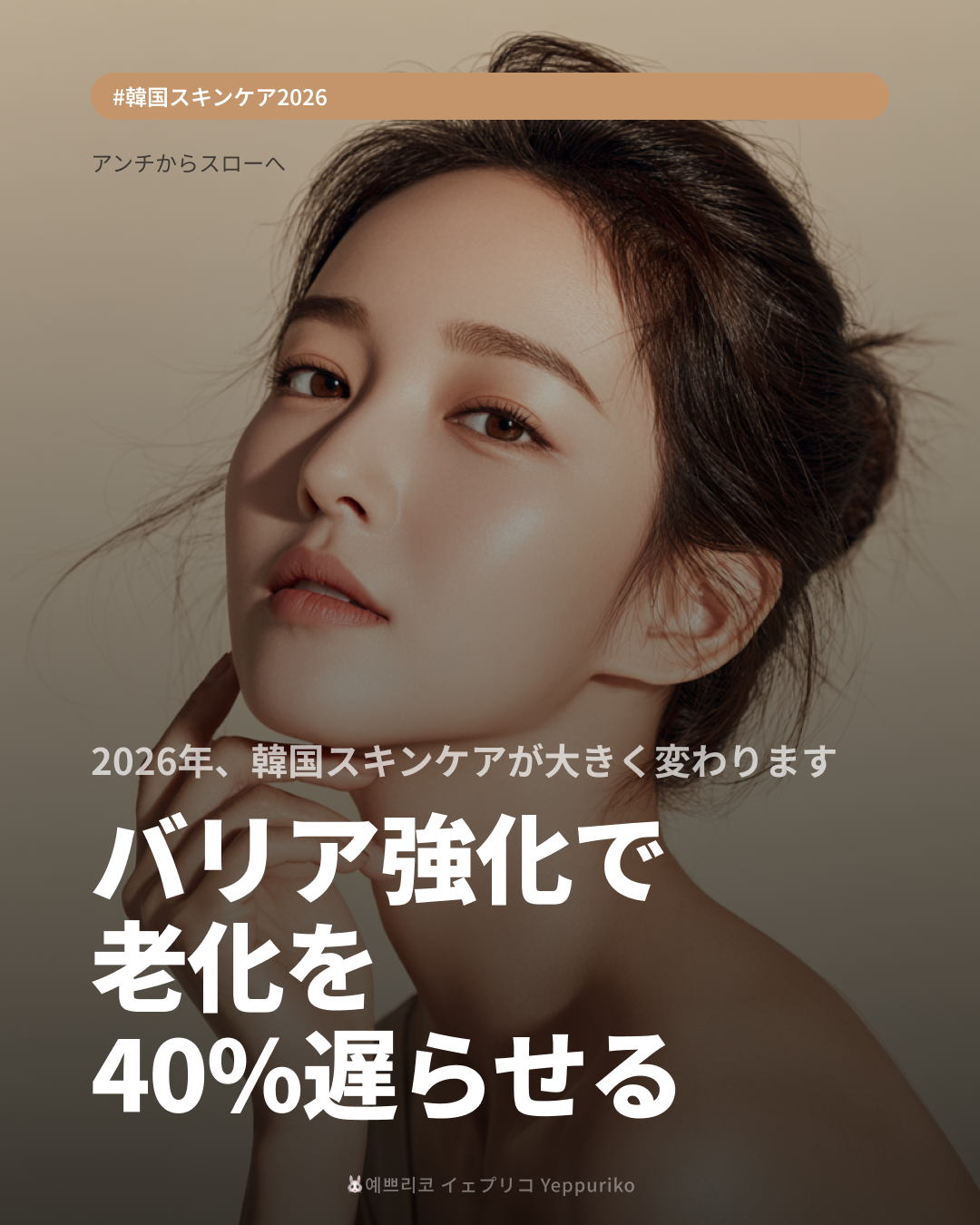
The Korean skincare market is currently entering a major turning point.
Until now, the mainstream concept of
“anti-aging (fighting the effects of aging)” has given way to
“slow aging (slowing down the pace of aging).”
Behind this shift is the fact that
research has shown that the health of the skin barrier plays a major role in the progression of aging.
Maintaining a healthy barrier function may
help slow the pace of aging, and this
scientific approach has become a key theme in Korean skincare in 2026.
🧴 From 10 Steps to 4–6 Steps: The Shift Toward Strategic Simplification

Once a symbol of Korean skincare,
the “10-step routine” is now being reevaluated.
The keyword for 2026 is
intelligent minimalism.
While reducing the number of steps,
“strategic simplification” is advancing to maximize results.
This is driven by the growing awareness that
overdoing skincare may
place a burden on the skin barrier.
✅ Benefits of Simplification
・Less friction
・Improved ingredient absorption
・Minimized burden on the skin
・Skincare that is easy to maintain
What matters is not the number of steps, but
the purpose and quality of each step.
🌿 3 Major Trends in Barrier-Friendly Ingredients

To achieve slow aging,
choosing ingredients that support the barrier function is essential.
In 2026, the following three ingredients are attracting particular attention in Korean skincare.
① Centella asiatica (CICA)
Known as an ingredient that supports wound healing
and helps promote collagen production.
It is also relatively easy to use on sensitive skin
or skin prone to inflammation.
② Ceramides
An important lipid component that makes up approximately 50% of the skin barrier.
It protects the skin from external irritants
and helps prevent moisture loss.
③ Niacinamide
At concentrations of 2–5%,
it is expected to offer multiple benefits, including brightening, barrier strengthening, and sebum control.
It is supported by substantial scientific evidence
and is included in many products.
💉 Regenerative Medicine Technology Goes Mainstream: Products Containing PDRN and Exosomes

Regenerative medicine ingredients previously used
in injection treatments at clinics
are now beginning to be applied in cosmetics.
PDRN (salmon DNA-derived ingredient)
It supports cell repair and regeneration
and is said to enhance the skin’s ability to recover.
It is also considered helpful in calming inflammation and supporting collagen production.
Exosomes (stem cell-derived growth factors)
They are expected to activate communication between cells
and help regulate the skin’s turnover.
We are entering an era in which
cell-level skincare can be pursued even at home.
✅ Characteristics of Regenerative Ingredients
As technology shifts from injections to cosmetics, the boundary between specialized treatments and everyday care is becoming blurred.
📊 How Digital Diagnostics Are Transforming Skincare
In Korea,
digital skin analysis using multispectral imaging technology
is becoming widespread.
・Barrier condition
・Depth of pigmentation
・Inflammation status
By visualizing factors such as these,
care based on
the actual condition of the skin, rather than guesswork,
becomes possible.
This is making personalized skincare
optimized for each individual a reality.
✨ Glass Skin 2.0: Skin That Glows from Within

The globally popular
glass skin concept is evolving as well.
Previously,
surface-level radiance was emphasized,
but in 2026’s Glass Skin 2.0,
・Barrier health
・Oil-moisture balance
・Skin turnover
and other aspects of
the skin’s internal health are prioritized.
This approach aims not just for appearance,
but for genuine, healthy beauty of the skin.
✅ Conditions for Glass Skin 2.0
A healthy barrier, an appropriate moisture-oil balance, a normal skin turnover cycle, and a clear, radiant complexion that seems to glow from within are essential.
🧪 The Arrival of New Functional Cosmetics
In Korean cosmetics in 2026,
products that combine technology and design are emerging.
UV Protection Patches
A
patch-type UV product with UV protection functions.
They are attracting attention for reducing the need for reapplication.
Skincare-Makeup Hybrids
Skincare ingredients
are incorporated into makeup products.
The idea is to
care for your skin while wearing makeup.
🏥 Skincare Essentials: Professional Care × Home Care
✅ Coordination with Clinic Care
By combining specialized treatments with daily care, greater results can be expected.・Barrier ingredients (ceramides・cica)
・Regenerative ingredients (PDRN・exosomes)
・Simple step structure
Keeping these points in mind is recommended.
✅ Key to Consistency
Rather than expecting results too quickly,
it is important to assess the results based on
the skin's turnover cycle (approximately 28 days).
✨ Summary
✔ Anti-aging → Slow aging
✔ 10 steps → Simplified to 4–6 simple steps
✔ Centella asiatica, ceramides, and niacinamide are gaining attention
✔ Increasing number of cosmetics formulated with PDRN and exosomes
✔ Precise care through digital skin analysis
✔ Glass Skin 2.0: Healthy beauty from within
✔ Evolution of functional cosmetics
✔ Integration of professional care and home care
Related Columns
- What Is PDRN? 9 Top Products to Buy in Korea
- How to Choose the 3 Major Korean Whitening Ingredients [2026 Edition] Differences and How to Use Glutathione, Niacinamide, and Vitamin C
- Mediheal is no longer just “green”—in 2026, using all three colors for different purposes is the new standard.
- 2026 Korean Skincare Rankings | Unpacking the Four Key Criteria Used
- Korean Beauty Treatments You Can Get During Your Free Time on a Seoul Trip | Complete Guide to Botox & Pico Toning
- What Is Hiro Wave? A Complete Guide, from How It Differs from Fillers to How Long It Lasts