Complete Guide to Korean Convenience Stores|From Differences Between the 4 Major Chains to Recommended Products

🏪 5 differences from Japan you should know before traveling to Korea, plus a list of must-buy products
Convenience stores are indispensable when traveling in Korea. In fact, the way they are called and used differs significantly from Japan.
In this guide, based on our experience traveling to Korea, we introduce how to choose among the 4 major chains, must-buy products, and local rules.
🎯 First, know this: “convenience store” won’t work in Korea

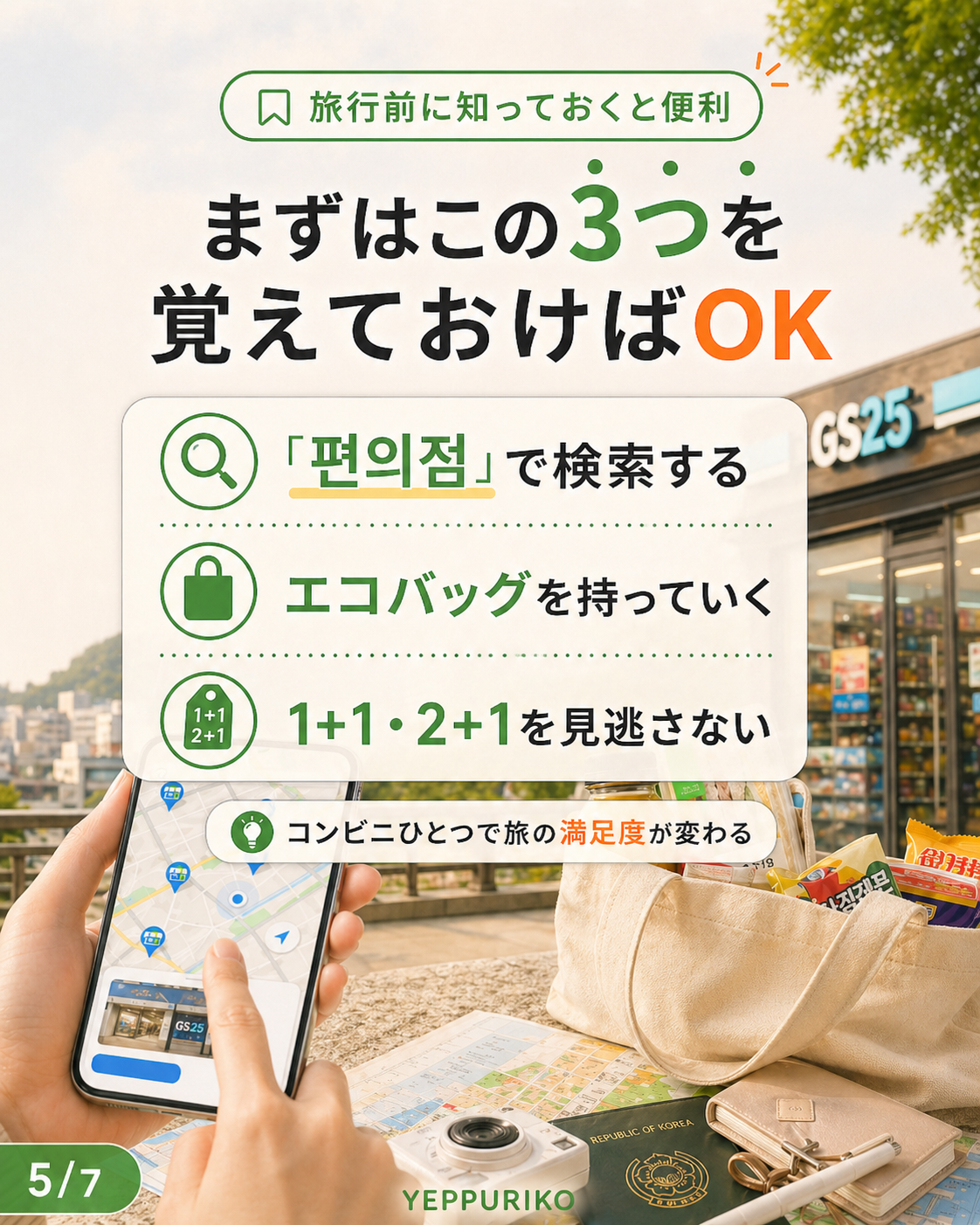
When looking for a convenience store during a trip to Korea, entering “コンビニ” into a map app may not bring up any results.
“コンビニ” is Japanese-made English, so it is not understood in Korea.
In Korean, they are called 편의점 (pyeonijeom). When searching for nearby stores in a map app, enter “편의점” to display a list.
In major areas, you can safely assume there will always be at least one store within a few minutes’ walk.
🏪 How are the 4 major chains different?
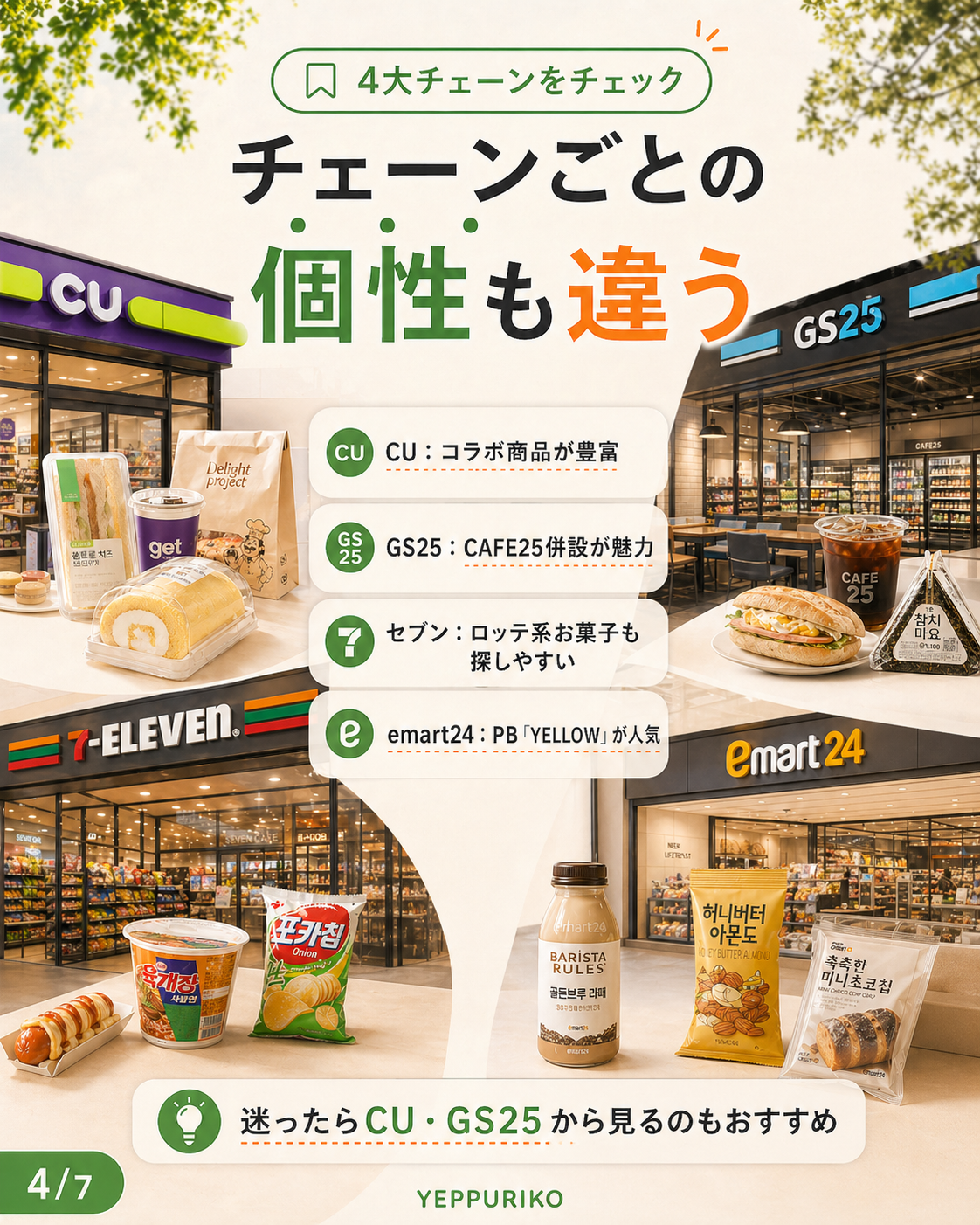
Four chains account for most of Korea’s convenience-store market. Each has its own characteristics, so you can choose one based on your purpose.
✅ CU
Operated by BGF Retail. With approximately 18,000 stores nationwide, it is one of the largest chains alongside GS25. It offers the PB brand “PBICK” and is known for its many collaborations with famous bakeries. CU is the best place to look for limited-edition sweets and seasonal products.
✅ GS25
Operated by GS Retail. Approximately 18,000 stores. In addition to the PB brand “YOUUS,” many locations have seating areas and “CAFE25,” making them ideal when you want to enjoy a coffee at a leisurely pace.
✅ セブンイレブン (Korea)
Operated by Korea Seven (under Lotte). Approximately 13,000 stores. It has an extensive selection of Lotte products, making it ideal for those who want to buy Lotte snacks and food items all at once.
✅ emart24
Operated by Shinsegae Group. Although it has slightly fewer stores at approximately 6,000, its PB brand “YELLOW” has stylish packaging, making it popular among those looking for souvenir-friendly products.
🇯🇵 5 differences from Japanese convenience stores

Although the way they are used may seem similar, the detailed rules are actually quite different. Understanding them before traveling to Korea can help reduce confusion while you are there.
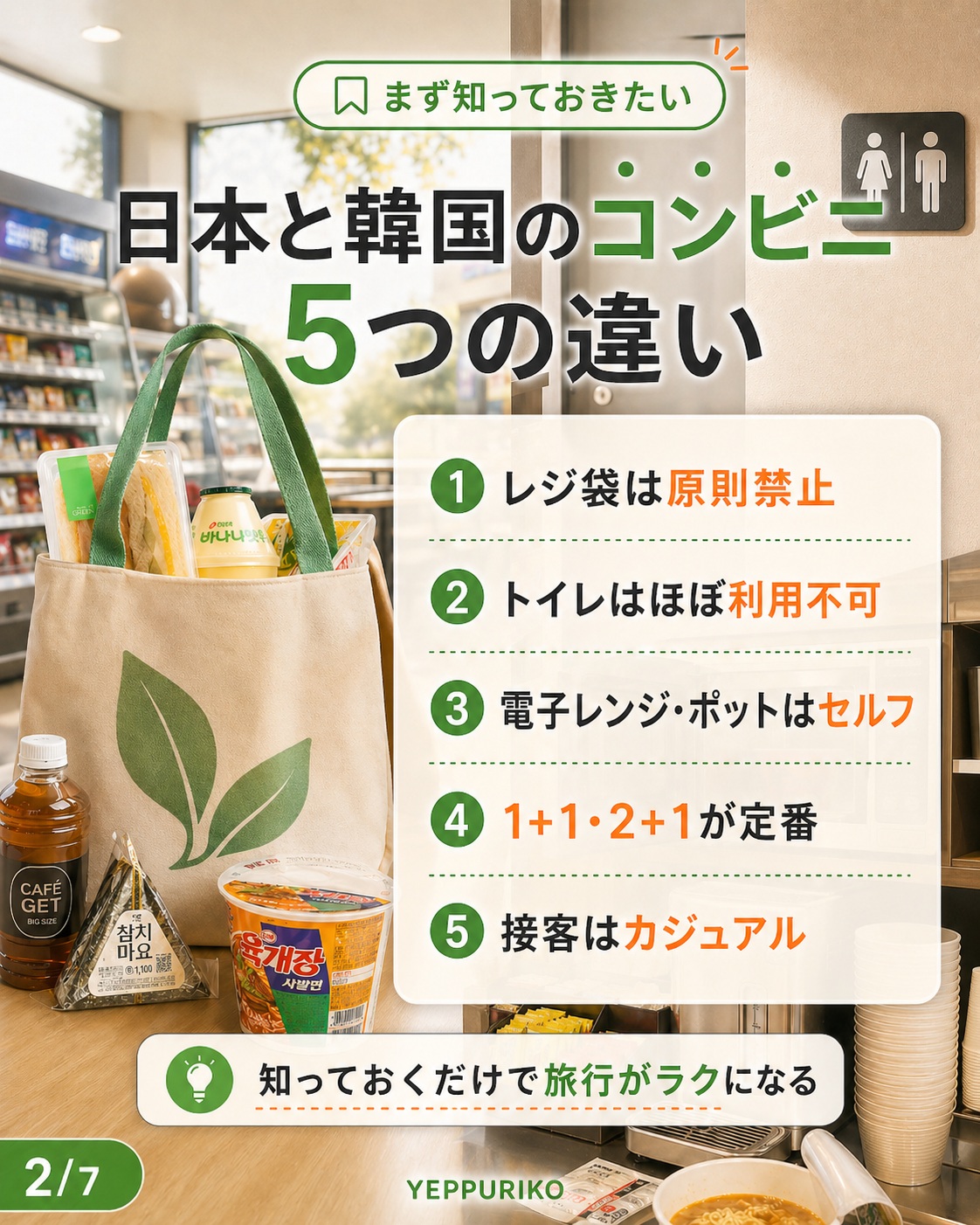
① Toilets are generally unavailable. Unlike in Japan, most Korean convenience stores do not have toilets. For peace of mind, check the locations of toilets in nearby subway stations or tourist facilities in advance.
② Plastic shopping bags are generally prohibited. Since November 2022, providing plastic bags at convenience stores has generally been prohibited. We recommend bringing an eco-bag.
③ Microwaves and hot-water dispensers are self-service. To add hot water to cup noodles or heat food, use the self-service machines installed in the store. There is no need to ask the staff.
④ Service is casual. It is more natural not to expect the same level of polite customer service as in Japan. Think of them as places to drop by casually.
⑤ The “1+1” and “2+1” sale culture. Buy one and get one free, or buy two and get one free—these bundle promotions are standard. The offer may apply not only to identical products but also to different products. Check the price tags as you choose, and you may find unexpectedly good deals.
🍜 Staple foods to choose for meals and snacks
Korean convenience stores offer an excellent selection of light meals and are perfectly suitable for eating between sightseeing activities.
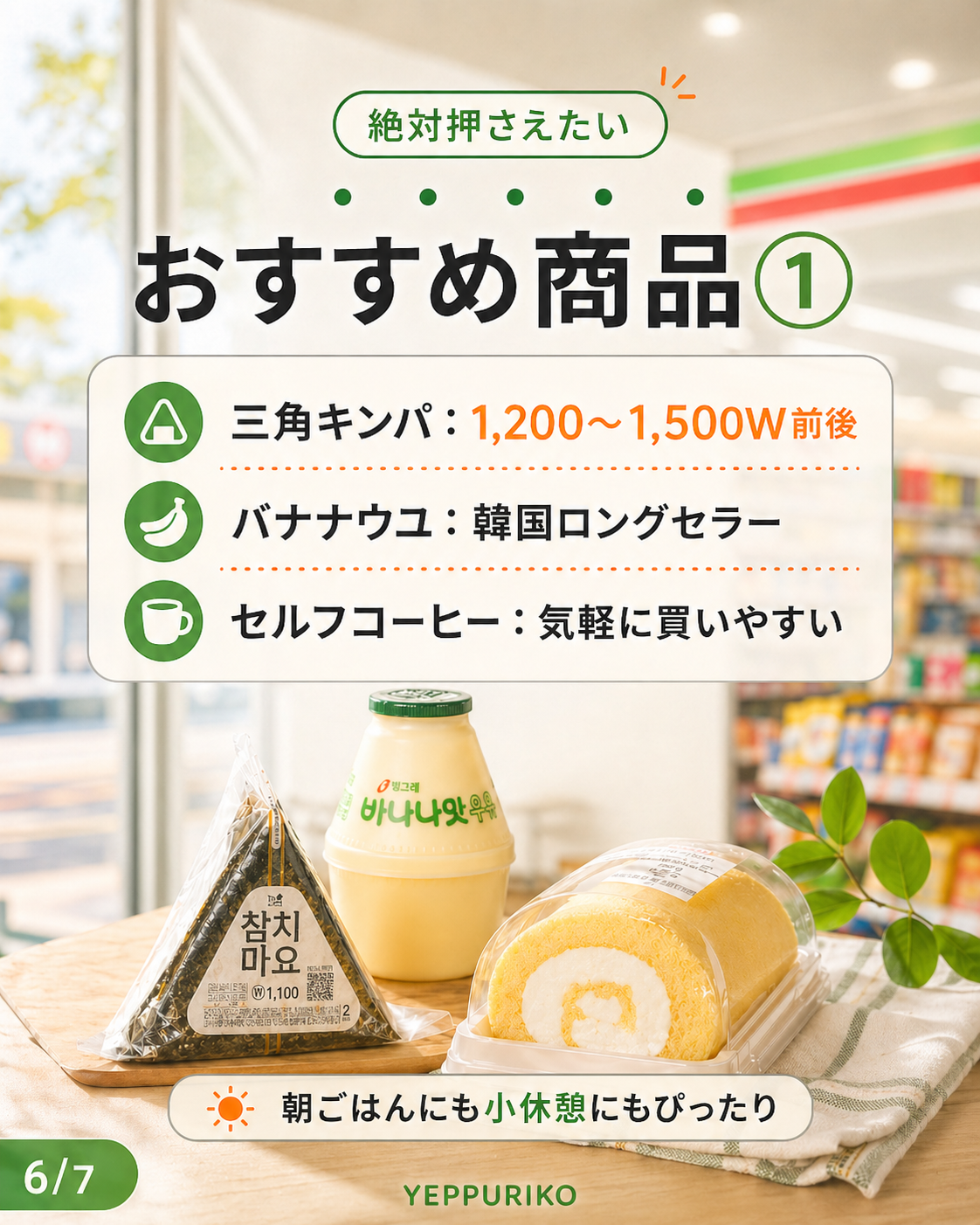
Triangle kimbap (삼각김밥). Similar to Japanese onigiri, these cost around 1,200–1,500 won each. There is a wide variety, including tuna, kimchi, and bulgogi, with unique flavors at each convenience store.
Cup noodles. Many stores carry more than 20 varieties, including numerous products that are difficult to find in Japan. You can eat them right away using the self-service hot-water dispenser in the store.
Hangang ramen experience. Purchase instant noodles and a dedicated container, then cook them using the automatic cooking machine in the store. You can enjoy this experience at convenience stores in tourist areas such as Myeongdong and Hongdae. It is popular with travelers because you can have the same experience without going to Hangang Park.
🧃 Drinks & sweets: this is where convenience stores show their strength
Many drinks cost less than half the price of those at cafés, making you want to stop by whenever you are on the move.
Banana milk (바나나우유). A long-selling product manufactured by Binggrae. It is a classic souvenir representing Korea. It also comes in several varieties.
Pouch drink + cup of ice set. The style of combining a fruit-flavored pouch drink with a cup of ice is popular, and sets can be purchased from around 2,000–2,500 won.
Self-service coffee. Self-service coffee at CAFE25 (GS25) and CU costs around 1,000–2,000 won. It is available at an affordable price compared with cafés.
Convenience-store sweets. Café-quality products are available at convenience stores, including towel cakes (thin crepe dough rolled with cream) and granola + Greek yogurt sets. CU regularly introduces collaboration products with famous bakeries.
🍿 Snacks & alcohol: classic choices that also make great souvenirs

Snacks are easy to purchase at convenience stores, which also carry a variety of conveniently sized products suitable as travel souvenirs.
3 classic snacks. Honey Butter Chips, Kkobuk Chip, and Home Run Ball (a long-selling product for more than 40 years) are available in small bags from around 1,500 won.
Fruit-flavored highballs. Fruit-based highballs, including varieties with pineapple, cost around 3,000–5,000 won. At stores with seating areas, you may be able to drink the alcohol you purchased on-site, but check each store’s rules before doing so.
✨ Summary: Korea convenience-store checklist before your trip
□ Search for “편의점 (pyeonijeom)” in your map app
□ Bring an eco-bag (plastic shopping bags are generally not provided)
□ Check the “1+1” and “2+1” signs before considering buying in bulk
□ Heat cup noodles and food yourself
□ Use the restroom at a subway station or tourist facility beforehand
□ Check CU first for collaboration and limited-edition sweets
□ Keep travel costs down with self-service coffee (1,000–2,000 won)
□ Consider banana milk, Honey Butter Chips, and Home Run Ball as souvenirs
Korean convenience stores can become more than just places to stop by between sightseeing activities—they may become memorable parts of your trip. Each chain has its own unique personality, so comparing several of them during your itinerary can also be fun.
📌 If you found this guide helpful
Bookmark it before traveling to Korea and refer back to it as often as needed. YEPPURIKO shares a wide range of information about Korean food, beauty, and travel preparation. Be sure to check out our other articles as well.
Related Columns
- Korea Starbucks LEAF TO COFFEE: 6 items, 2 mugs not in stores
- 10 Must-Buy Items at Korean Convenience Stores, Starting from 900 Won
- Korea's tax refund starts from 15,000 won
- The Perfect Myeongdong & Anguk Beauty 1-Day Course
- The Best Budget Hotels in Seoul by Area
- The Right Choice Among 8 Myeongdong Currency Exchange Offices by Arrival Time