9 Key Differences Between Korean and Japanese Spas | The Ultimate Jjimjilbang Comparison Guide
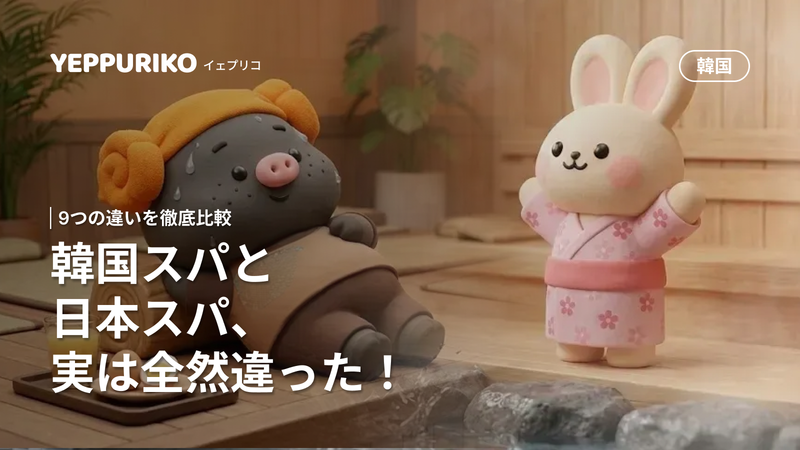
You’ll Regret Not Knowing!
Japanese super sento and Korean jjimjilbang are “completely different” 🧖♀️
This is Yeppuriko,
your one-stop guide to enjoying Korean beauty, travel, and gourmet experiences with confidence.
A jjimjilbang is something you’ll want to experience at least once on a trip to Korea.
It may look similar to a Japanese super sento, but in fact, it’s a completely different culture.
This time, we’ll thoroughly and clearly compare the differences between Korean and Japanese spa culture.
We’ll explain in detail the points that may confuse you if you go without knowing, as well as tips for enjoying the experience even more.
After reading this, you can make your jjimjilbang debut with confidence.
You’ll be able to fully enjoy Korea’s unique spa culture ✨
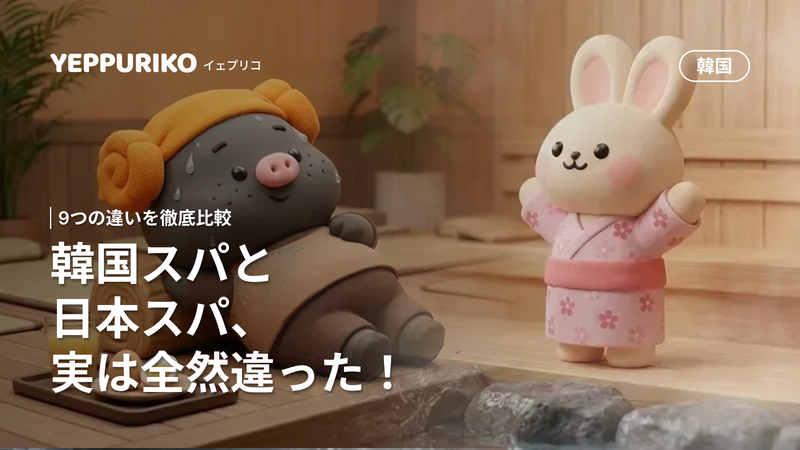
🚻 Are There Mixed-Gender Areas?|This Is the Biggest Difference!
🇯🇵 Japanese Super Sento
Large public baths: Separate for men and women
Saunas: Separate for men and women
Rest areas: Separate for men and women (or partially shared)
In Japan, areas where people bathe naked are basically completely separated.
There is a strong cultural emphasis on privacy, and it is very rare for men and women to use a sauna together.
🇰🇷 Korean Jjimjilbang
Large public baths: Separate for men and women (the same as in Japan)
Saunas: Mixed-gender (専用ウェア worn)
Rest areas: Mixed-gender
Dining areas: Mixed-gender
Nap rooms: Mixed-gender
The biggest feature of Korea is that after changing into専用ウェア, men and women can enjoy the saunas and rest areas together.
Being able to spend time together as a couple or family is part of the appeal.
💡 Key Point
Since you wear専用ウェア, it is less intimidating even for first-timers.
They are popular as classic destinations for dates and family trips.
This style is not often seen in Japan, but it is perfectly common in Korea.
Knowing this difference will help you enjoy your visit without any confusion on the day ♪
⏰ Opening Hours and Length of Stay|24-hour Operations Are the Norm in Korea
🇯🇵 Japan
Opening hours: Around 10:00–24:00
Length of stay: 2–3 hours is typical
Japanese super sento are places where people quickly wash off their sweat and head home.
They are often used as places to refresh for a few hours after work or on holidays.
🇰🇷 Korea
Opening hours: Many facilities are open 24 hours
Length of stay: Some people spend a leisurely half day to a full day there
At Korean jjimjilbangs, the standard is to “spend the whole day relaxing.”
You can spend your time as you please, following a routine of eating → sauna → taking a nap → sauna again…
They are also convenient for filling time before late-night or early-morning flights,
and some travelers use them as an alternative to accommodation.
💡 Key point
Jjimjilbangs are also a popular choice for filling time before or after a flight or for keeping hotel costs down.
Their appeal lies in being able to relax without worrying about the time.
🌡️ Sauna Temperatures|Korea Offers Low-Temperature Settings That Are Beginner-Friendly
🇯🇵 Japan
High-temperature sauna: 80–90°C
Features: Dry saunas are the norm
Japanese saunas are hot, offering a style where you work up a sweat all at once in a short time.
It’s perfect for sauna lovers, but beginners may sometimes find it a little too intense.
🇰🇷 Korea
Low-temperature saunas: Typically 40–70°C
Types: A wide variety of materials, including loess, salt, charcoal, and rock salt
Korean saunas are the type where you stay in for a longer period and work up a sweat gradually.
Another appeal is being able to enjoy the differences between the various materials.
Traditional hanjeungmak saunas can reach high temperatures of 90–150°C,
but they can be experienced as “one of the options to choose from.”
💡 Key point
Korea offers a wide range of temperature options, so it’s easy for beginners to find facilities that are comfortable to enter.
You’re less likely to end up thinking, “It’s too hot—I can’t do this…,” and can enjoy it as if you were touring different saunas✨
🍽️ Classic foods|Jjimjilbang meals are a uniquely Korean experience
🇯🇵 Japan
Classic menu items:
- Coffee milk / fruit milk
- Soba, seafood rice bowls, and more
Relax with a drink after your bath and some time in a massage chair.
The experience tends to be simple and laid-back.
🇰🇷 Korea
Classic menu items:
- Smoked boiled eggs (maifan stone eggs)
- Sikhye (a sweet and refreshing traditional Korean beverage)
- Seaweed soup
- Tteokbokki / chicken / cup noodles
Many facilities have full-service restaurants attached, and the menus are quite extensive.
Enjoying a meal at a jjimjilbang has become a well-established tradition in Korea.
💡 Key point
“Sikhye + smoked eggs” is the perfect combo after working up a sweat✨
In Korea, eggs are eaten by tapping on the shell before peeling them.
Be sure to experience that scene you often see in Korean dramas!
🧘 Cultural differences in how people spend their time|Quietness vs entertainment
🇯🇵 Japan
Atmosphere: A space for quiet relaxation
Style: Taking your time alone
What is valued: Manners and quietness
Japanese super sento are “places of healing” where people restore both body and mind.
The belief that spending time quietly contributes to comfort is deeply rooted in the culture.
🇰🇷 Korea
Atmosphere: Strongly oriented toward being a social space
Style: Having fun and chatting with family, friends, or your partner
Culture: Eating, sleeping, and going back in again… repeating the cycle
In Korea, there is even a word called “찜캉스 (jjimkangseu).”
It is a coined term combining “jjimjilbang (찜질방)” and “vacation,” meaning to spend a relaxing holiday at a jjimjilbang.
💡 Key point
Japan = “Quietness and healing”
Korea = “Entertainment and socializing”
It is interesting that even at the same type of “spa facility,” the expectations for how to enjoy it are different✨
🏠 Range of facilities|Some in Korea are on the level of an “indoor resort”
🇯🇵 Japanese super sento
Facilities:
- Various baths (open-air baths, carbonated baths, etc.)
- Saunas (1–2 types)
- Dining area
- Rest area
- Massage chairs
They generally have everything you need, and my impression is that most facilities are centered around “the baths.”
🇰🇷 Korean jjimjilbangs
Facilities:
- Large communal baths (5–6 types of baths)
- A wide variety of saunas (5–8 types, including loess, salt, charcoal, and ice saunas)
- Large relaxation rooms (multiple areas)
- Nap rooms and capsule rooms
- Full-fledged dining halls
- PC rooms / game corners / karaoke, etc. (depending on the facility)
- Fitness rooms
- Massage and esthetic rooms
- Some facilities even have pools and water parks 😳
Many Korean jjimjilbangs are quite large,
and their appeal lies in the comprehensive experience of being able to “spend an entire day inside the facility.”
💡 Key point
Their strength is that “sauna + food + relaxation + nap” can all be enjoyed in one place.
For families, some facilities allow adults and children to enjoy themselves separately✨
💰 Prices|Korea often feels like a better value when considering the overall experience
🇯🇵 Japan
・Public bathhouses: Around 500 yen (varies by region)
・Super sento: Approximately 800–2,000 yen
※Some facilities charge separately for towels and loungewear, so additional costs may apply.
🇰🇷 Korea
Jjimjilbang: 10,000–20,000 won (approximate)
Commonly included: indoor clothing and towels (※varies by facility)
Even at a similar price point, when you factor in the length of stay and how you can spend your time inside,
many people feel that there is “more to experience.”
💡 Key point
If you prioritize cost performance and want to “enjoy lots of different things for longer,” Korean jjimjilbangs are a great match.
🌊 Differences in Hot Spring Culture|“What you go there to enjoy” is different
🇯🇵 Japan
Hot springs are “a gift from nature.”
There is a deep-rooted culture of enjoying “the hot spring itself,” including the water quality and its benefits, the scenery, and the tranquility.
🇰🇷 Korea
Korea also has hot springs, but in urban areas, jjimjilbangs (saunas and multifunctional facilities) are more commonly used.
In addition to “warming up,” they are characterized by a strong emphasis on “spending time, gathering, and relaxing.”
💡 Key point
Even though they are both places to “warm up,” the different cultural significance is what makes them interesting.
📝 Differences in Etiquette|Rules that are good to know
🇯🇵 Japan
・Many facilities do not allow tattoos (※restrictions are gradually easing, and policies vary by facility)
・A quiet atmosphere
・Many facilities ask visitors to keep conversations in the sauna to a minimum
・Bringing in food and drinks is generally not allowed
🇰🇷 Korea
・“Some facilities allow tattoos” (※be sure to check each facility’s rules)
・Conversation is a natural part of the atmosphere in shared areas.
・Whether outside items are allowed varies by facility
👙 Differences in Swimsuit Rules
Japan: Swimsuits are allowed at some mixed-gender hot springs
Korea: Swimsuits are NOT allowed in jjimjilbangs! You must wear the designated clothing
💡 Key Point
Since “the facility’s rules are the correct answer,” it’s best to follow the signs at the entrance and the staff’s instructions⚠️
🎀 Yangmeori Culture|That Familiar Look from Korean Dramas
🇯🇵 Japan
People generally just place a towel on their head, and there are few specific rules about how to wrap it.
🇰🇷 Korea
Yangmeori (양머리) culture!
This uniquely Korean classic style involves wrapping a towel like sheep’s horns and placing it on your head.
Perfect for photos too✨
💡 Key Point
It’s also handy when you don’t want to get your hair wet.
At some facilities, staff may even show you how to wrap it🐑💛
🏡 Cultural Background|Differences in Everyday Habits
🇯🇵 Japan
It is common for homes to have a bathtub, and people have a daily habit of soaking in a hot bath.
As a result, super sentos tend to be seen as a “special refreshment you enjoy once in a while.”
🇰🇷 Korea
With many homes centered around showers, jjimjilbangs have become a familiar part of daily life as places to warm up thoroughly.
They are popular as casual “wellness spots” you can drop by anytime.
💡 Key Point
Differences in housing conditions and lifestyle habits have influenced the development of spa culture✨
🎯 Recommended Ways to Enjoy Them|Enjoy Each in Your Own “Right” Way
🇯🇵 Japanese Super Sento
Ideal way to spend your time:
- Warm up slowly in the bath
- Follow the sauna → cold bath → relaxation routine
- Have coffee milk on the way home
- Length of stay: 2–3 hours
Perfect when you want to quietly unwind on your own.
🇰🇷 Korean Jjimjilbang
Ideal way to spend your time:
- Wash your body thoroughly in the large communal bath
- Visit various saunas
- Take a break with sikhye and smoked eggs
- Rest for a while in the nap room
- Head back to the sauna
- Take photos with yangmeori too🐑✨
- Length of stay: Half a day to a full day
Recommended for days when you want to take it easy without worrying about the time.
💡 Key Point
“I only planned to stop by briefly, but before I knew it, I’d been there for half a day” really does happen♪
※When including facility names:
“Dragon Hill Spa,” which was often mentioned as a standard recommendation in the past, has been reported as temporarily closed (permanently closed), so if you include it, we recommend adding a note saying “Check the latest information.”
Instead, in Seoul, it is safer to give examples of facilities that “currently have usage information available,” such as SPAREX in Dongdaemun.
In Busan, 新世界スパランド is also a popular choice, and information on its business hours is available.
💖 Summary|Knowing the differences makes it twice as enjoyable
🇯🇵 People who are suited to Japanese super sento
✓ Want to relax quietly
✓ Want to refresh in a short time
✓ Want to fully enjoy the qualities of the hot spring water
🇰🇷 People who are suited to Korean jjimjilbangs
✓ Want to spend the whole day relaxing
✓ Want to enjoy it with family or friends
✓ Want to enjoy everything from the sauna, meals, and relaxation to taking a nap
✓ Want to use it to fill time before or after a flight
When traveling to Korea, be sure to experience the “uniquely Korean” spa culture at a jjimjilbang✨
And… be sure to try sikhye and smoked eggs at least once😋
Related Columns
- Korea Starbucks LEAF TO COFFEE: 6 items, 2 mugs not in stores
- Busan PASS: The Difference Between BIG3 and BIG5
- 8 HYBE sacred spots and how to get around Seoul
- 10 Must-Buy Items at Korean Convenience Stores, Starting from 900 Won
- When it comes to taking Korean ramyeon home, the deciding factor is the toppings
- The 3 Korean transit cards — which one is actually the right choice?