2026 Entry into Korea: Pitfalls of K-ETA Exemption
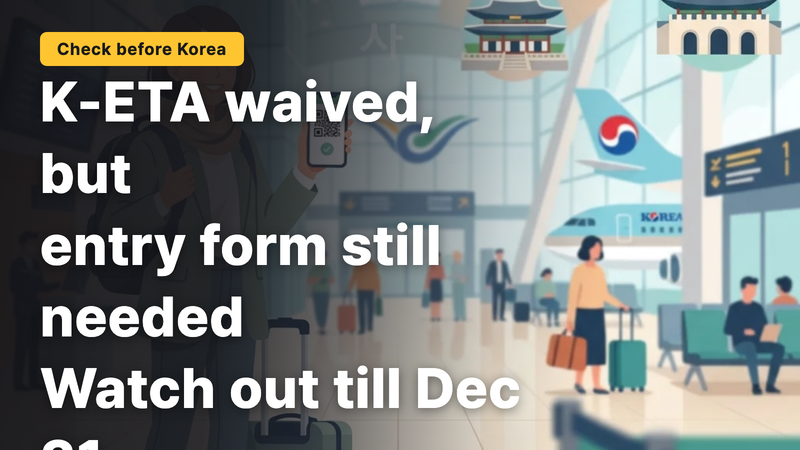
To put it simply, K-ETA is not required to enter Korea in 2026. The exemption for 22 countries, including Japan, has been extended through December 31, 2026. You might think you can just head to the airport with your passport in hand—but there is one additional procedure instead.
Starting January 1, 2026, the yellow paper arrival card handed out on flights was discontinued. You are now expected to submit an online e-Arrival Card (electronic arrival card) before arrival and receive a QR code. In 2026, some travelers are arriving without knowing this and having to line up again at the kiosks before immigration.
In other words, there are two things to check before departure: “Is my passport on the exemption list?” and “Have I submitted the electronic arrival card?” Let’s look at them in order. ✈️
Key Points for Entering Korea in 2026
・K-ETA: Exemptions for 22 countries, including Japan, are in effect through December 31, 2026. It will be required again starting January 1, 2027.
・e-Arrival Card: Required for all foreign nationals who do not have a K-ETA. Free of charge; submit online up to 72 hours before arrival.
・If you obtain a K-ETA (10,000 won, valid for 3 years), you are exempt from submitting the e-Arrival Card.
K-ETA Exemption Covers 22 Countries. Deadline: December 31, 2026
The Korean government has extended the temporary K-ETA (electronic travel authorization) exemption for citizens of 22 countries and regions through December 31, 2026. The measure aims to promote tourism to Korea, and eligible travelers can skip both the 10,000-won fee and the application review wait.
- Asia-Pacific: Japan, Taiwan, Hong Kong, Singapore, Macau, Australia, New Zealand
- Europe: United Kingdom, France, Germany, Italy, the Netherlands, Spain, Sweden, Norway, Denmark, Finland, Belgium, Poland, Austria
- Americas: United States (including Guam), Canada
Visa-free stays for tourism are 90 days in many countries, but the conditions vary by country. For the conditions applicable to your passport, it is safest to check Hi Korea (Korea’s immigration information portal).
Another detail that is easy to overlook is the deadline. K-ETA will be required again starting January 1, 2027. For itineraries spanning the year-end and New Year holidays, the applicable rule depends not on your return date but on which side of the cutoff your entry date falls. Applications can be submitted at k-eta.go.kr for 10,000 won (approximately US$8); approval can take up to 72 hours, and once approved, it can be used multiple times over three years.
Paper Arrival Cards Discontinued. The New Hurdle Is the e-Arrival Card
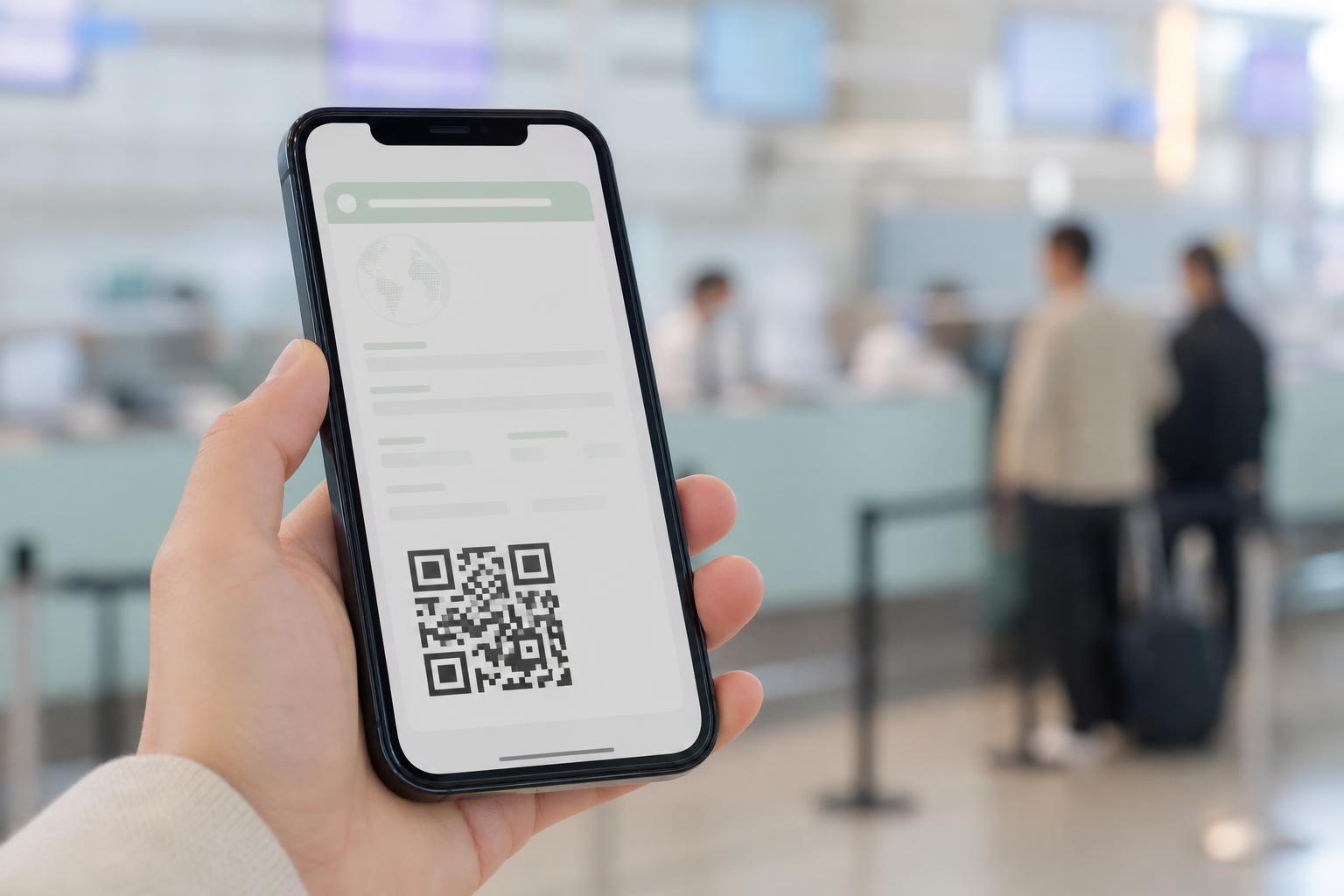
Starting January 1, 2026, arrival cards will no longer be handed out on flights. Foreign travelers without a K-ETA must submit an electronic arrival card before going through immigration. This is where most people run into trouble.
Submit it at e-arrivalcard.go.kr—it’s free. You can submit it starting 72 hours before arrival, and the required information is the same as on the paper declaration form: flight number, address of your accommodation in Korea, and contact information. Once completed, a QR code is issued, and all you have to do is have it scanned at the inspection gates at Incheon International Airport (인천국제공항) or Gimhae International Airport (김해국제공항).
One thing to note is that, since the form is submitted online, you need a stable internet connection. Airport kiosks also tend to have long lines. Rather than struggling with airport Wi-Fi while exhausted after a long-haul flight, it’s faster to complete the form at home before departure and save a screenshot. 📱
“The transition to fully digital entry procedures in 2026 is part of Incheon Airport’s ‘Smart Entry’ initiative. It has become faster for travelers who are prepared, but bottlenecks are emerging among those who are unaware of the electronic arrival card.” — Korea Tourism Organization industry report (Q1 2026)
What’s the difference between K-ETA and the e-Arrival Card?
| Item | K-ETA | e-Arrival Card |
|---|---|---|
| Cost | ₩10,000 (approximately US$8) | Free |
| Validity | 3 years・multiple entries | For each individual entry |
| Processing time | Up to 72 hours for approval | QR code issued immediately after submission |
| Eligible travelers | Nationals not exempt from the requirement | Anyone without a K-ETA |

Choosing to get a K-ETA anyway
Even nationals of exempt countries can apply for a K-ETA, which is then valid for three years. In addition, those with an approved K-ETA are exempt from submitting the e-Arrival Card. If you visit Korea frequently, it may make sense to pay ₩10,000 once and skip filling out arrival cards altogether for subsequent entries.
There is one condition: the K-ETA is linked to your passport number. Even if it is still within its validity period, you will need to apply again after renewing your passport, so if your passport has a short remaining validity period, it’s more efficient to renew it first and then apply. If you visit Korea about once a year, simply submitting the free e-Arrival Card each time is the more straightforward option. The deciding factor is how many times you visit per year.

Pre-departure checklist and the current status of Q-CODE
Some airlines have also begun checking passengers’ electronic entry status at check-in. To make sure you don’t miss anything, go through these steps in order before heading to the airport.
- Passport validity: Check that it has at least 6 months remaining. K-ETA is linked to your passport number.
- Check the exemption list: If your country is not among the 22 exempt countries, apply for K-ETA (approval can take up to 72 hours, so applying at least 5 days in advance is recommended).
- Submit the e-Arrival Card: Submit it free of charge on the official website from 72 hours before arrival. Save the QR code.
- Check whether Q-CODE is required: Check whether your departure location falls under a designated quarantine management area.
- Take screenshots: Do not rely solely on email; save images of the QR code and your accommodation address (including the address in Hangul).
Q-CODE (the pre-entry quarantine information system) is not uniformly required for travelers from major countries as of 2026. However, quarantine authorities regularly update the list of designated management areas according to infectious disease conditions. If you are entering from one of the applicable areas, guidance for Q-CODE will appear while you are completing the e-Arrival Card. If it does not appear, you are generally not subject to the requirement, but it does not hurt to be prepared by saving your vaccination certificate on your smartphone.
The duty-free allowance is a total of US$1,000. Before buying cosmetics in bulk
Another thing to keep in mind along with the entry procedures is the duty-free allowance for items you bring into the country. If you plan to buy skincare products or electronics in bulk, make sure you know the value and quantity limits in advance.
| Category | 2026 duty-free allowance |
|---|---|
| General duty-free allowance | US$1,000 in total (per person) |
| Alcohol | 2 bottles (up to 2L in total・maximum US$400) |
| Tobacco | 200 cigarettes (1 carton) |
| Perfume | 100ml |
If your total purchases are likely to exceed the allowance, it is better to plan your budget on the assumption that you will declare them, so you do not run into trouble at the airport.
Summary
For travel to Korea in 2026, Japanese passport holders only need their passport and the e-Arrival Card QR code. K-ETA is exempt until December 31, and will be required again for arrivals from January 1, 2027. Only those who visit several times a year may want to obtain K-ETA for 10,000 won and skip the arrival card.
It takes five minutes before departure. Whether you watch the lines at the kiosks after arrival or head straight into Seoul on the AREX (airport railroad・공항철도)—that is the only difference. Checking the latest applicable requirements once on the official website before your trip is enough.✨
Frequently Asked Questions
Do Japanese passport holders need K-ETA for travel to Korea in 2026?
No. Japan and 21 other countries and regions are exempt from K-ETA until December 31, 2026. However, it will be required again for arrivals from January 1, 2027, so for itineraries spanning the year-end and New Year holidays, the answer depends on which date you enter the country.
When and where should I submit the e-Arrival Card?
You can submit it free of charge on the official website, e-arrivalcard.go.kr, from 72 hours before arrival. You will need to enter your flight number, accommodation address in Korea, and contact information. After submission, the QR code issued can be scanned at the immigration inspection gate. Airport kiosks tend to get crowded, so it is best to complete the process before departure and save a screenshot.
Should I obtain K-ETA even if I am exempt?
It is advantageous for those who travel to Korea frequently. With an approved K-ETA, you are exempt from submitting the e-Arrival Card, and it can be used multiple times over three years for 10,000 won (approximately US$8). However, because it is linked to your passport number, you must reapply when your passport is renewed. If you travel about once a year, the free electronic arrival card is sufficient.
Related Columns
- Korea Starbucks LEAF TO COFFEE: 6 items, 2 mugs not in stores
- Busan PASS: The Difference Between BIG3 and BIG5
- 8 HYBE sacred spots and how to get around Seoul
- When it comes to taking Korean ramyeon home, the deciding factor is the toppings
- The 3 Korean transit cards — which one is actually the right choice?
- Seoul FW: The Right Way to Enjoy 7 Days for Free